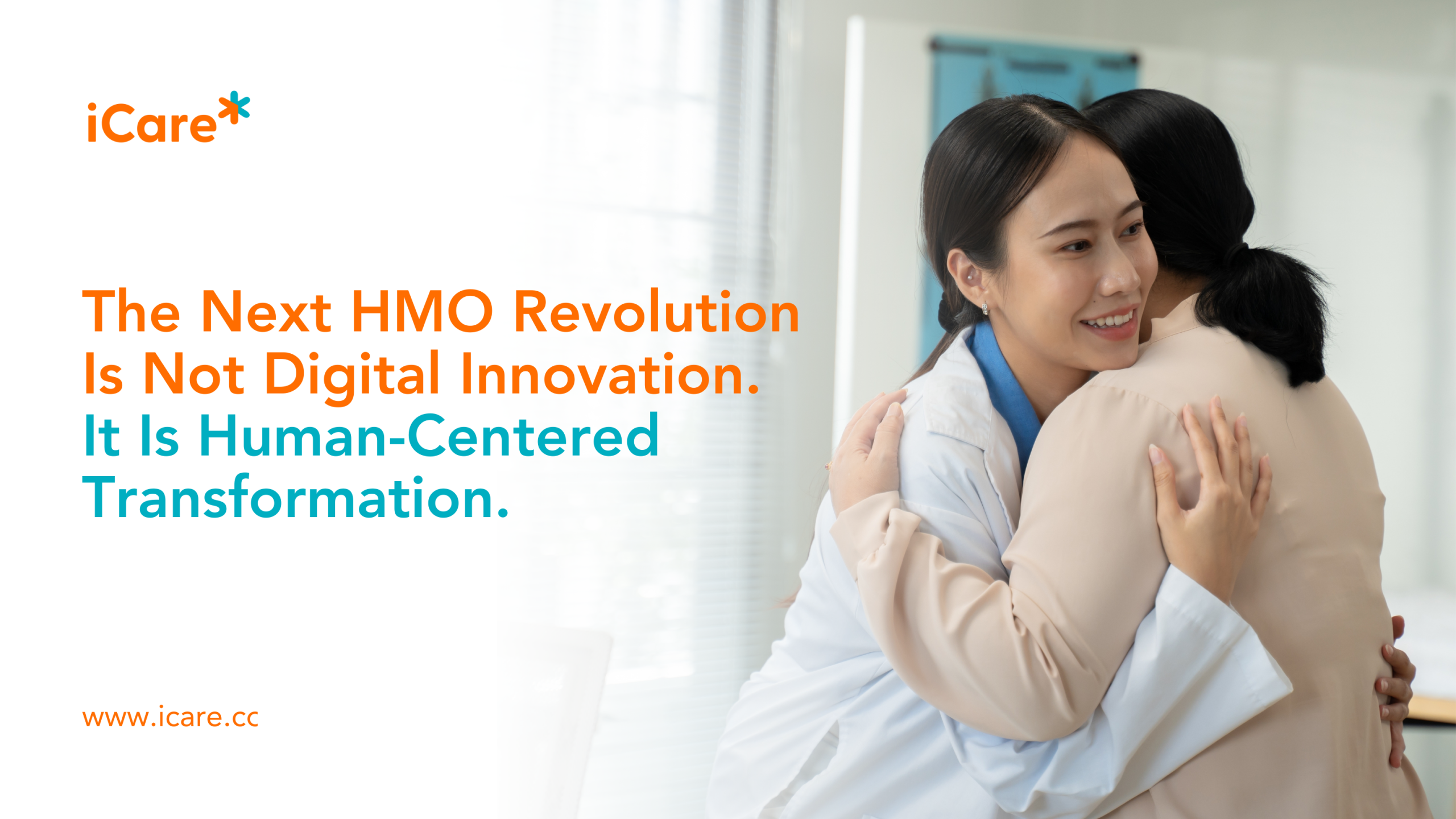
July 2, 2026 The Next HMO Revolution Is Not Digital Innovation. It Is Human-Centered Transformation
For Philippine employers and health insurers, the promise of clinical AI is not simply faster claims, another app, or a more automated approval process. The larger opportunity is to redesign managed healthcare around trust, preventive care, customer service, and the lived realities of Filipino workers and families.
For many Filipino workers, the HMO card becomes most visible at moments of uncertainty. A child has a fever after office hours. A parent needs a specialist referral. An employee wonders whether a persistent symptom is serious enough for a hospital visit. A member opens a mobile app, calls customer service, searches for an accredited clinic, or asks Human Resources what is covered. The experience is not only medical. It is financial, emotional, logistical, and deeply human.
This is the point often missed in discussions about digital health. The future of the HMO in the Philippines will not be determined only by which company launches the most advanced platform, the fastest chatbot, or the most sophisticated claims engine. Those tools matter. But the next HMO revolution is not a digital innovation alone. It is a human-centered transformation.
That distinction is becoming more important as the scale of managed healthcare grows. The Insurance Commission reported that the Philippine HMO industry recorded PHP 101.56 billion in revenues and PHP 74.64 billion in healthcare benefits and claims in 2025, based on unaudited interim financial statements submitted by 27 of 28 licensed HMOs as of 31 December 2025. Healthcare benefits and claims increased by 19.35 percent from 2024. These figures show that HMOs are no longer peripheral players in the country’s health financing landscape. They are increasingly central to how employers, employees, families, hospitals, clinics, and healthcare providers experience access to care.
The pressure is also visible in the broader health economy. The Philippine Statistics Authority reported that total health expenditure reached PHP 1.87 trillion in 2025, equivalent to 6.7 percent of gross domestic product. Household out-of-pocket payment still accounted for 41.2 percent of current health expenditure, while voluntary health care payment schemes, which include private health insurance and related arrangements, accounted for 12.3 percent. In practical terms, many Filipinos remain exposed to direct medical spending even as public financing and employer-sponsored benefits expand.
For employers, this is no longer a narrow benefits administration issue. It is a workforce strategy issue. Medical inflation is reshaping the economics of employee benefits, workplace health, and corporate health planning. WTW projected that healthcare benefit costs in the Philippines would continue to rise at a double-digit rate of 18.3 percent in 2025, citing increased use of health services, rising hospital and clinic costs, higher professional fees, and frequent diseases among the drivers. In a separate Asia-Pacific outlook, WTW projected a 16.1 percent gross medical trend for the Philippines in 2026.
The instinctive corporate response to this environment is often digitalization. Make claims faster. Move letters of authorization online. Add telemedicine. Automate customer service. Build dashboards for HR and finance teams. These are useful improvements, especially for large employers with distributed workforces and for SMEs and Small and Medium Enterprises that need affordable and administratively simpler healthcare solutions. But digitalization can also create a false sense of progress. A confusing process remains confusing even when it is moved to an app. A member who does not understand coverage remains underserved even when information is technically available online. A faster approval process does not necessarily mean earlier care, better prevention, or improved workforce wellbeing.
This is where the 2026 study, Transformation Versus Innovation in Digital Health Care and the Future of Clinical AI, offers a useful warning to healthcare leaders. The article argues that genuine institutional transformation must precede scalable innovation. It cautions that digital tools can become trapped in existing organizational habits unless healthcare institutions redesign roles, governance, clinical workflows, and culture around meaningful change. In the context of clinical AI, the study emphasizes that the challenge is not merely technical. It is also cultural, organizational, and ethical.
For the HMO and insurance industry, the implication is significant. Innovation asks, “How can we process this claim faster?” Transformation asks, “How can we help this member reach the right care earlier, avoid preventable deterioration, and feel supported throughout the process?” Innovation asks, “Can AI answer member questions?” Transformation asks, “Can AI, human care teams, doctors, HR leaders, and provider networks work together so that care becomes easier to navigate and safer to use?”
The difference matters because the Philippine healthcare experience is often fragmented. A worker may have an HMO benefit but may not know which hospital or clinic is accredited, whether a consultation is covered, whether a specialist requires prior approval, or whether telemedicine is appropriate for the concern. A CFO may see rising utilization and higher premiums but have limited visibility into whether spending is improving health outcomes. HR may invest in employee benefits but struggle to translate coverage into a better employee experience. A healthcare provider may be part of a big network but still face administrative friction that affects both patients and clinicians.
A human-centered HMO model treats these frictions as strategic issues, not merely service complaints. It recognizes that healthcare access depends on information, trust, timing, affordability, and continuity. The best managed healthcare systems do not simply pay bills. They guide members through decisions, encourage preventive care, support chronic disease management, coordinate with hospitals and clinics, and help employers understand health risks without compromising individual privacy.
This direction is consistent with the policy ambition of the Universal Health Care Act. Republic Act No. 11223 declares a policy of ensuring that Filipinos have access to promotive, preventive, curative, rehabilitative, and palliative health services without financial hardship. It also defines primary care as initial-contact, accessible, continuous, comprehensive, and coordinated care, and recognizes the role of a primary care provider as a navigator and coordinator of health services. While HMOs operate within a private managed healthcare context, the broader direction of the law reinforces a principle that business leaders should take seriously: health systems are most valuable when they help people move through care before illness becomes more costly and complex.
Clinical AI may eventually become one of the tools that makes this shift possible. In an HMO setting, AI can help identify patterns in claims, flag members who may benefit from preventive screening, improve care navigation, support fraud and waste detection, assist in triage, and help customer service teams provide more consistent information. For HR and Human Resources leaders, anonymized and properly governed population health insights may support better workplace health programs. For CFOs, more intelligent utilization management may help address medical inflation without reducing fair access to care. For employees, the benefit could be more practical: fewer delays, clearer next steps, and better guidance when health decisions feel urgent.
Yet the same technology can also create risk if it is deployed without human-centered governance. In healthcare, AI cannot be treated like ordinary office automation. A poorly designed model may reinforce inequity, make opaque recommendations, misinterpret local context, or become a hidden gatekeeper between a patient and needed care. The World Health Organization has warned that while artificial intelligence holds promise for diagnosis, treatment, research, and public health, ethics and human rights must be placed at the center of its design and use. WHO’s guidance identifies principles including protecting autonomy, promoting human well-being and safety, ensuring transparency, fostering responsibility, ensuring inclusiveness and equity, and making AI responsive and sustainable.
This is especially relevant in the Philippines, where health data systems, digital literacy, infrastructure, provider availability, and access to care vary widely. The country’s participation in the HealthAI Global Regulatory Network, announced in 2026, signals growing attention to safe, transparent, and fair AI use in health. HealthAI noted that the Philippines had moved to Phase 4 maturity in the Global Digital Health Monitor in 2024, while also identifying continuing challenges such as data standardization, interoperability across fragmented health systems, and infrastructure requirements.
Data privacy is another non-negotiable issue. The Data Privacy Act of 2012 governs the processing of personal information in the Philippines, including collection, storage, use, retrieval, consultation, consolidation, blocking, erasure, and destruction. In healthcare, where sensitive personal information is involved, trust depends not only on compliance but also on clear communication. Members need to know how their information is used, when AI is involved, and when human review is available.
For HMOs, this means the future will depend less on technology procurement and more on operating model redesign. A trusted HMO must be able to connect digital channels with a provider network of hospitals, clinics, physicians, specialists, and allied health professionals. It must ensure that customer service can resolve real member concerns, not merely route tickets. It must support employers that want affordable health insurance and employee benefits while also addressing preventive care, occupational health, mental health, and chronic disease risks. It must be able to serve both leading companies and large employers with complex needs, as well as SMEs that require simple, dependable, and cost-conscious managed healthcare solutions.
This is also where industry examples are useful, provided they are understood as part of a broader transformation rather than isolated product announcements. iCare, for instance, has introduced Telemed7, a service allowing eligible members to connect with licensed doctors through Viber for non-emergency and common medical concerns, with the service positioned around fast access, digital automation, and human-centered consultation support. iCare’s mobile app also allows members to request letters of authorization, file reimbursements, access a digital card, request callbacks, receive medicine reminders, and track wellness indicators such as blood pressure and blood sugar. These features illustrate how digital healthcare innovations can reduce friction in member journeys. The more important question for the industry is whether such tools are integrated into a larger model of care navigation, provider coordination, preventive health, and member trust.
That question is not only relevant to iCare. It applies to every HMO, insurer, employer, and healthcare provider in the Philippines. A mobile app can improve convenience, but transformation requires accountability for the whole experience. Telemedicine can make care more accessible, but it must be clear when a case should be escalated to a clinic, hospital, emergency department, or specialist. AI can support decision-making, but it must be supervised, explainable, and designed around Filipino realities. A big network may look impressive on paper, but its real value is measured by whether members can find the right provider, receive timely care, and avoid unnecessary confusion.
For CEOs and business owners, the strategic lesson is that health benefits are becoming part of organizational resilience. Companies compete not only on compensation but also on the quality of employee experience, and healthcare is one of the most consequential parts of that experience. Top employer brands are increasingly expected to provide benefits that employees can understand, access, and trust. A plan that looks attractive in procurement documents but performs poorly during a medical need can erode confidence in both the employer and the HMO.
For CFOs, the challenge is to balance affordability with value. Medical inflation cannot be managed sustainably by shifting friction to employees or limiting access in ways that create larger costs later. The more promising path is to improve navigation, prevention, data governance, plan design, and provider collaboration. Preventive care and early intervention are not soft benefits. They are mechanisms for reducing avoidable complications and improving the productivity of a workforce that depends on timely access to healthcare.
For HR and CHROs, the task is to move from benefit administration to workforce wellbeing strategy. This means asking whether employees know how to use their HMO, whether customer service is responsive, whether mental health and occupational health are meaningfully addressed, whether chronic disease support exists, and whether provider access is realistic for employees outside major business districts. It also means protecting employee trust by ensuring that health data is not used in ways that create fear or discrimination.
For policymakers and regulators, the rise of AI in health coverage raises questions about standards, accountability, interoperability, and consumer protection. Executive Order No. 192 transferred jurisdiction over HMOs from the Department of Health to the Insurance Commission for regulation and supervision of their establishment, operations, and financial activities, while the DOH retained authority over medical matters. That regulatory split reflects the dual nature of HMOs: they are financial and operational institutions, but their work affects clinical access and public trust.
The next stage of HMO development in the Philippines should therefore not be framed as a race to automate. It should be framed as a test of whether managed healthcare can become more preventive, more coordinated, more transparent, and more humane. The winning model will not be the one that removes people from healthcare. It will be the one that uses technology to help people reach the right doctor, the right clinic, the right hospital, the right benefit, and the right decision earlier.
The future of clinical AI may be powerful, but the future of HMOs will still be judged by human outcomes. Did the members understand what to do? Did the employee receive care before the condition worsened? Did the employer manage costs without weakening trust? Did the provider spend less time on avoidable administrative friction? Did the system protect privacy and fairness? These are the questions that matter.
The next HMO revolution is not a digital innovation. It is a human-centered transformation. In the Philippines, that means building managed healthcare around the realities of Filipino workers and families: the need for affordable access, trusted guidance, reliable customer service, strong provider networks, preventive care, and dignity during moments of vulnerability. Technology can accelerate that future. It cannot substitute for it.
Sources and References
Chew, Boon-How. “Transformation Versus Innovation in Digital Health Care and the Future of Clinical AI.” Journal of Medical Internet Research, 2026, Vol. 28, e105359. DOI: 10.2196/105359.
Available at: https://www.jmir.org/2026/1/e105359
JMIR Publications. “JMIR News: AI Innovations, Digital Health Transformations, and New Medicare Models.” Newswise, July 1, 2026.
Available at: https://www.newswise.com/articles/jmir-news-ai-innovations-digital-health-transformations-and-new-medicare-models
Insurance Commission of the Philippines. “HMO Industry Performance as of 31 December 2025.” Based on submitted unaudited interim financial statements. The report lists PHP 101.56 billion in total HMO revenues and PHP 74.64 billion in healthcare benefits and claims.
Available at: https://www.insurance.gov.ph/wp-content/uploads/2026/02/Annex-A-Q4-2025-HMO-Industry-Performance-Report.pdf
Philippine Statistics Authority. “Government Contributes 46.5 Percent to the Country’s Current Health Spending in 2025.” Philippine National Health Account, released June 18, 2026. The PSA reported total health expenditure of PHP 1.87 trillion in 2025, equivalent to 6.7 percent of GDP, with household out-of-pocket payment accounting for 41.2 percent of current health expenditure.
Available at: https://psa.gov.ph/statistics/pnha
WTW. “Philippines healthcare benefit costs projected to continue its double-digit increase at 18.3% in 2025, WTW survey finds.” January 6, 2025.
WTW. “Asia Pacific medical inflation continues to soar in 2026.” December 11, 2025. The report projects a 16.1 percent gross medical trend for the Philippines in 2026.
Available at: https://www.wtwco.com/en-ph/insights/2025/12/asia-pacific-medical-inflation-continues-to-soar-in-2026
World Health Organization. “Digital Health.” WHO Health Topics. WHO states that digital health can support more efficient, sustainable, affordable, and equitable health systems when aligned with country needs.
Available at: https://www.who.int/health-topics/digital-health
World Health Organization. Ethics and Governance of Artificial Intelligence for Health: WHO Guidance. June 28, 2021. The guidance discusses the ethical risks of AI in health and the need to place ethics and human rights at the centre of AI design, deployment, and use.
Available at: https://www.who.int/publications/i/item/9789240029200
HealthAI. “The Philippines Joins the HealthAI Global Regulatory Network to Advance Responsible AI Adoption.” March 18, 2026.
Available at: https://healthai.agency/the-philippines-joins-the-healthai-grn/
Republic Act No. 11223. “Universal Health Care Act.” Supreme Court E-Library.
Available at: https://elibrary.judiciary.gov.ph/thebookshelf/showdocs/2/86448
Executive Order No. 192, Series of 2015. “Transferring the Regulation and Supervision Over Health Maintenance Organizations from the Department of Health to the Insurance Commission.” Supreme Court E-Library.
Available at: https://elibrary.judiciary.gov.ph/thebookshelf/showdocs/5/65785
Republic Act No. 10173. “Data Privacy Act of 2012.” National Privacy Commission. The law classifies health information as sensitive personal information and sets conditions for lawful processing and security obligations.
Available at: https://privacy.gov.ph/data-privacy-act/
iCare. “iCare makes healthcare more convenient with Telemed7: Doctor in 7 minutes.” February 12, 2026.
Available at: https://icare.com.ph/2026/02/12/icare-makes-healthcare-more-convenient-with-telemed7-doctor-in-7-minutes/
iCare. “Our iCare Mobile App.” The page lists member app functions including LOA requests, reimbursement filing, callback requests, digital member card access, medicine reminders, wellness tracking, and Telemed7 access.
Available at: https://icare.com.ph/our-icare-mobile-app/
iCare. “iCare HMO Philippines.” The company website states that iCare has more than 2,000 partner hospitals and clinics nationwide and more than 50,000 accredited doctors and medical practitioners.
Available at: https://icare.com.ph/
