

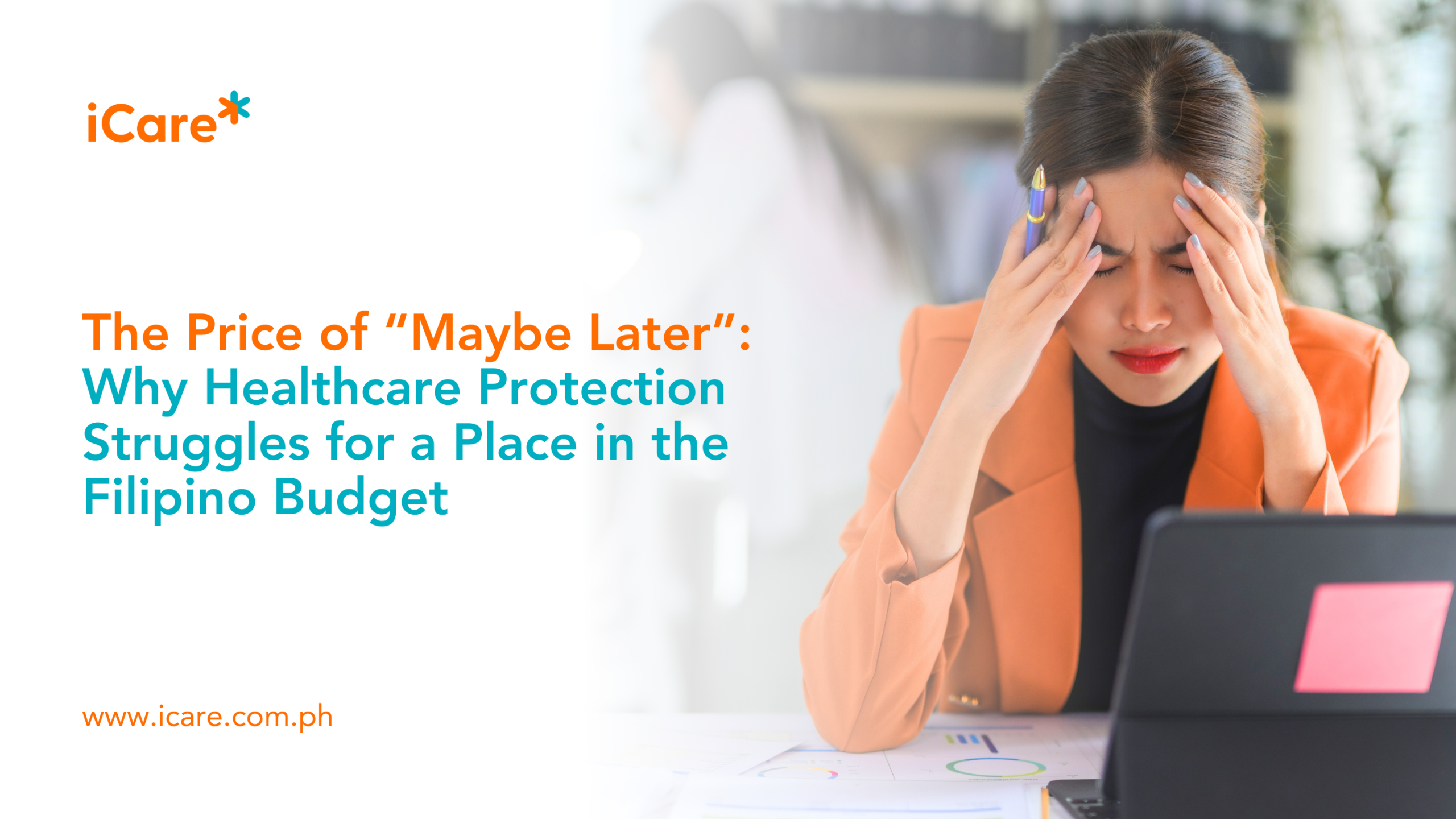
July 29, 2026 The Price of “Maybe Later”: Why Healthcare Protection Struggles for a Place in the Filipino Budget
HMO and insurance coverage may be recognized as necessary, yet limited income, family obligations, complex benefits and the difficulty of valuing protection before illness make healthcare preparedness easier to postpone.
In a household budget, urgency is rarely theoretical. Food must be purchased, electricity must remain connected, transport must be paid, and school expenses arrive according to a calendar. A contribution to a parent’s medicine or a relative’s emergency may also demand an immediate response. An HMO membership or private health insurance premium operates differently. Its value may not become visible this week, this month or even this year.
That difference helps explain why healthcare protection can remain in the category of “maybe later”, even among people who recognize its importance.
It would be inaccurate to reduce this behavior to irresponsibility or to claim that Filipinos simply prefer discretionary purchases over necessary protection. National data do not establish such a comparison. The evidence instead points towards a more complicated combination of affordability constraints, perceived lack of need, product complexity, provider accessibility, and the influence of family and trusted social networks.
The culturally familiar idea of panghihinayang offers a useful entry point, provided it is treated with care. There is no national dataset measuring panghihinayang as a cause of low HMO or insurance uptake. In ordinary use, however, the word captures a recognizable tension: the reluctance to release money today for a benefit that may remain unseen. That tension becomes stronger when the same money can address a visible household need.
Healthcare protection, in other words, does not struggle for a place in the Filipino budget only because consumers misunderstand risk. It struggles because future protection is competing against present obligations.
Affordability comes before attitude
The strongest available evidence suggests that the first barrier is financial.
The Bangko Sentral ng Pilipinas’ 2021 Financial Inclusion Survey found that insurance ownership, excluding PhilHealth, stood at 17 percent of Filipino adults. When PhilHealth was included, the share rose to 48 percent. Among those without adequate protection, 56 percent said they lacked sufficient funds, while 7 percent had not found a product suited to their needs. Only 16 percent said insurance was unnecessary, down from 25 percent in 2019.
These findings undermine an easy but unhelpful narrative. The primary problem is not that most consumers reject the idea of protection. Many appear to understand its value but cannot fit it into their available cash flow.
The survey was conducted during the economic disruption of the COVID-19 pandemic, which limits how directly its figures can be applied to current conditions. Even so, its distinction between perceived need and purchasing capacity remains important. A person may believe that health insurance is necessary and still be unable to absorb a fixed monthly or annual payment.
Insurance Commission data show that the formal insurance market continues to expand. Insurance penetration, measured as total premiums relative to gross domestic product, increased from 1.78 percent in the first quarter of 2024 to 1.89 percent in the first quarter of 2025. Insurance density, or premiums per capita, rose from P965.56 to P1,094.94 during the same period. These figures indicate market growth, but they do not show whether protection is evenly distributed across income groups or whether individual coverage is sufficient. (Insurance Commission)
A growing market can therefore coexist with a large protection gap. More premiums may be collected while millions of households continue to depend primarily on PhilHealth, personal savings, borrowing or employer-provided benefits.
The cultural meaning of spending is relational
Filipino household finance is not always organized around the individual. Income may be expected to support children, parents, siblings, and other relatives. Financial decisions can therefore carry a social and moral meaning that conventional descriptions of consumer choice do not fully capture.
The immediate duty to pay a parent’s prescription or contribute to a family emergency can feel more compelling than purchasing protection against an uncertain future illness. One expense responds to a person whose need is already visible. The other asks the buyer to imagine a loss that may or may not occur.
This does not mean family solidarity is an obstacle to financial protection. It means that protection products enter a financial environment where money is often shared, negotiated, and allocated across relationships.
BSP data illustrate how important these relationships can become during periods of financial pressure. In 2021, 45 percent of Filipino adults reported outstanding loans, up from 33 percent in 2019. Among borrowers, 47 percent obtained credit from family and friends. Borrowing was the leading coping mechanism for emergencies and other financial needs, and informal sources were valued for quick access, minimal documentation, and flexible payment terms.
These figures should not be interpreted as proof that families routinely substitute for HMOs or insurers. They do show that informal relationships remain part of the country’s financial infrastructure. When formal protection is absent or insufficient, the financial consequences of illness can spread across relatives rather than remain with the patient alone.
This is where panghihinayang takes on a broader meaning. The hesitation is not necessarily about keeping money for personal consumption. It may involve uncertainty whether paying a premium is more responsible than keeping cash available for a family member’s immediate need.
The paradox is that postponing protection can expose the same family to a much larger financial demand later.
The value of protection is difficult to see before it is used
An HMO plan is unusual among household purchases because a member may pay for it while hoping never to require its most expensive benefits. This can make a year without hospitalization feel like a year in which the premium produced no return.
That interpretation overlooks the basic function of risk pooling. The value of coverage lies partly in transferring the possibility of a large, uncertain medical expense into a more predictable payment. Yet this value can remain abstract, particularly when benefits are explained mainly through technical terms, exclusions and maximum coverage limits.
A 2025 qualitative study published in Discover Health Systems examined factors affecting private health insurance uptake in the Philippines. Researchers interviewed 17 Filipino adults with and without private coverage. Participants identified perceived additional cost, lack of perceived need, difficulty understanding policy terms, application barriers, benefit quality, and the proximity of partner healthcare providers as important considerations. Family members, friends, and trusted advisers also influenced decisions.
The study’s small, convenience-based sample means its findings cannot be generalized to the entire Filipino population. The authors themselves noted that online recruitment may have favored urban and higher-income participants. Its value lies not in estimating how common each barrier is, but in showing how different barriers interact.
Price is only one part of the decision. A consumer may also ask whether the plan covers an existing illness, whether dependents can be included, which hospitals and clinics are accredited, how approval works, and whether the benefit will still require substantial out-of-pocket spending.
When these answers are difficult to obtain, delaying the purchase may feel safer than entering a contract the consumer does not fully understand. What appears to be resistance may partly be a rational response to complexity and uncertainty.
The price of waiting reaches beyond the premium
The consequences of limited protection become clearest when treatment is already necessary.
The Philippine Statistics Authority reported that the country’s total health expenditure reached P1.87 trillion in 2025, 15.1 percent higher than the P1.63 trillion recorded in 2024. Household out-of-pocket payments accounted for 41.2 percent of current health expenditure, while voluntary healthcare payment schemes accounted for 12.3 percent. Per-capita health spending rose by 14 percent to P15,223. (Philippine Statistics Authority)
Out-of-pocket expenditure includes payments made directly by households when healthcare is received. It does not automatically mean that every patient was uninsured. Even people with PhilHealth, an HMO or health insurance may pay for services, medicines or charges outside their coverage. The data nevertheless show how much financial responsibility continues to reach families at the point of care.
The World Health Organization defines financial hardship from healthcare as a situation in which out-of-pocket spending reduces a household’s ability to meet basic needs or afford other goods and services. This is why financial protection is considered a central component of universal health coverage, alongside access to essential services. (World Health Organization)
The Philippine Universal Health Care Act automatically includes every Filipino in the National Health Insurance Program and establishes financial risk protection as a core policy objective. It also recognizes HMOs, private health insurance and healthcare provider networks within the wider health system. Public and private coverage should therefore be understood as layers of protection, not as interchangeable products or substitutes for an effective national system. (Lawphil)
For households, the practical question is not simply whether they have “insurance”. It is whether their combination of PhilHealth entitlement, employer benefit, HMO plan, private insurance, savings and accessible providers can respond to the healthcare risks they actually face.
Healthcare protection must become usable before hospitalization
One reason an HMO can feel like a reluctant purchase is that its value is often associated with confinement in a hospital. This makes coverage seem distant to a healthy member.
Managed healthcare can become more visible when members regularly encounter it through preventive care, primary consultations, diagnostics, chronic disease management and timely referrals. A provider network should not be judged only by the number of hospitals listed in a directory. Its practical value also depends on whether members can reach appropriate doctors, clinics, laboratories and pharmacies, and whether the approval process works when care is needed.
The 2025 Philippine study on private health insurance uptake found that participants considered hospital accreditation, preferred physicians, the extent of benefits and the proximity of partner providers when evaluating coverage. This suggests that healthcare access is not a secondary feature of the product. It is part of the purchase decision itself.
Customer service has a similar role. A plan whose rules become clear only during an emergency is not merely inconvenient. It can deepen the perception that paying for protection is risky. Clear explanations of exclusions, waiting periods, pre-existing conditions, limits, authorization procedures and out-of-pocket responsibilities should be treated as essential consumer protection.
For iCare and the broader HMO industry, this has a strategic implication. The competition is not simply to offer the biggest network or the lowest membership fee. It is to make managed healthcare understandable and accessible enough that members can recognize its value before a major claim occurs.
Employers can change the decision architecture
Employer-sponsored HMO coverage remains particularly important because it changes the way protection enters the household budget. Instead of requiring an employee to initiate and finance the entire purchase independently, an employer can negotiate group coverage, subsidize the cost, and make enrolment part of the employee benefits system.
The BSP’s 2021 survey found that insurance ownership was closely associated with employment and socioeconomic status. Workers and business owners were more likely to report insurance coverage, while young adults, people with limited education and those in lower economic groups had lower levels of ownership.
This gives CEOs, CFOs and Human Resources leaders a role that extends beyond procurement. For large employers, HMO benefits can form part of workforce wellbeing, employee experience, and the organization’s ability to attract and retain talent. For SMEs and small and medium enterprises, the challenge is to provide credible healthcare access without allowing costs to become financially unsustainable.
The cost pressure is real. Based on submissions from 27 of the Philippines’ 28 licensed HMOs, healthcare benefits and claims reached P74.64 billion in 2025, 19.35 percent higher than the previous year. Membership fees increased by 26.82 percent to P98.46 billion. These changes are not a pure measure of medical inflation because they may also reflect enrolment, utilization and benefit design. They nevertheless show the scale of financial pressure across the sector. (Insurance Commission)
Mercer Marsh Benefits’ 2026 research projected that medical trend rates would remain in double digits across most markets, driven by medical inflation, greater utilization, changes in treatment and more expensive technologies. Its estimates are international rather than a Philippines-specific forecast, but they reinforce the need for employers to manage cost without making healthcare inaccessible to workers. (Mercer)
The best response is not automatically to reduce benefits or transfer more expenses to employees. Employers can examine utilization patterns, strengthen primary and preventive care, improve benefits education, review the geographic reach of the provider network and make customer service performance part of HMO evaluation.
The purpose is to ensure that an employee benefit does not exist only on paper.
From panghihinayang to preparedness
Healthcare protection will continue to struggle in the Filipino budget as long as it is presented as an abstract promise competing with concrete obligations.
Financial literacy can help people understand risk, but education alone cannot overcome insufficient income. A consumer cannot be persuaded into affordability. Nor can better advertising compensate for inaccessible clinics, unclear exclusions or a claims experience that undermines trust.
The more credible path is to reduce the distance between payment and value. That means health plans with understandable terms, affordable entry points, and benefits that can be used through preventive care and everyday healthcare access. It means a provider network designed around where members live and work, not merely a long list of facilities. It means employers treating HMO coverage as part of workforce strategy rather than an annual purchasing exercise.
It also requires a more constructive understanding of Filipino family culture. Family support should not be romanticized as an unlimited source of emergency money, nor dismissed as dependence. It is a powerful social resource that becomes financially vulnerable when illness arrives without adequate formal protection.
The cultural shift is not from caring for relatives to prioritizing oneself. It is from waiting until the family must respond to a medical crisis to preparing before that crisis occurs.
The price of “maybe later” is not merely the premium that was not paid. It is the possibility that healthcare will eventually have to be purchased at the worst possible moment, when choices are fewer, costs are immediate and the entire family has something to lose.
Sources and References
Bangko Sentral ng Pilipinas. 2021 Financial Inclusion Survey Report. 2022.
Available at: https://www.bsp.gov.ph/Inclusive%20Finance/Financial%20Inclusion%20Reports%20and%20Publications/2021/2021FISToplineReport.pdf
Montemayor, E. D., Chua, K. C., et al. “Factors Affecting Uptake of Private Health Insurance in the Philippines.” Discover Health Systems, Volume 4, Article 98, 2025.
Available at: https://link.springer.com/article/10.1007/s44250-025-00279-7
Philippine Statistics Authority. “Government Contributes 46.5 Percent to the Country’s Current Health Spending in 2025.” 18 June 2026.
Available at: https://psa.gov.ph/content/government-contributes-465-percent-countrys-current-health-spending-2025
Insurance Commission of the Philippines. “Insurance Penetration, Density Rise in Q1 2025 Vis-à-Vis Q1 2024.” 21 May 2025.
Available at: https://www.insurance.gov.ph/wp-content/uploads/2025/05/IC-Press-Release-21-May-2025.pdf
Insurance Commission of the Philippines. HMO Industry Performance as of 31 December 2025. 3 February 2026.
Available at: https://www.insurance.gov.ph/wp-content/uploads/2026/02/Annex-A-Q4-2025-HMO-Industry-Performance-Report.pdf
Republic of the Philippines. Republic Act No. 11223, Universal Health Care Act. 20 February 2019.
Available at: https://lawphil.net/statutes/repacts/ra2019/ra_11223_2019.html
World Health Organization. “Universal Health Coverage.” Updated 5 December 2025.
Available at: https://www.who.int/news-room/fact-sheets/detail/universal-health-coverage-%28uhc%29
World Health Organization. “Financial Hardship Due to Out-of-Pocket Health Spending and Its Components.”
Available at: https://www.who.int/data/gho/data/themes/topics/financial-protection
Mercer Marsh Benefits. Health Trends 2026. 2025.
Available at: https://www.mercer.com/insights/total-rewards/employee-benefits-optimization/mmb-health-trends/
