



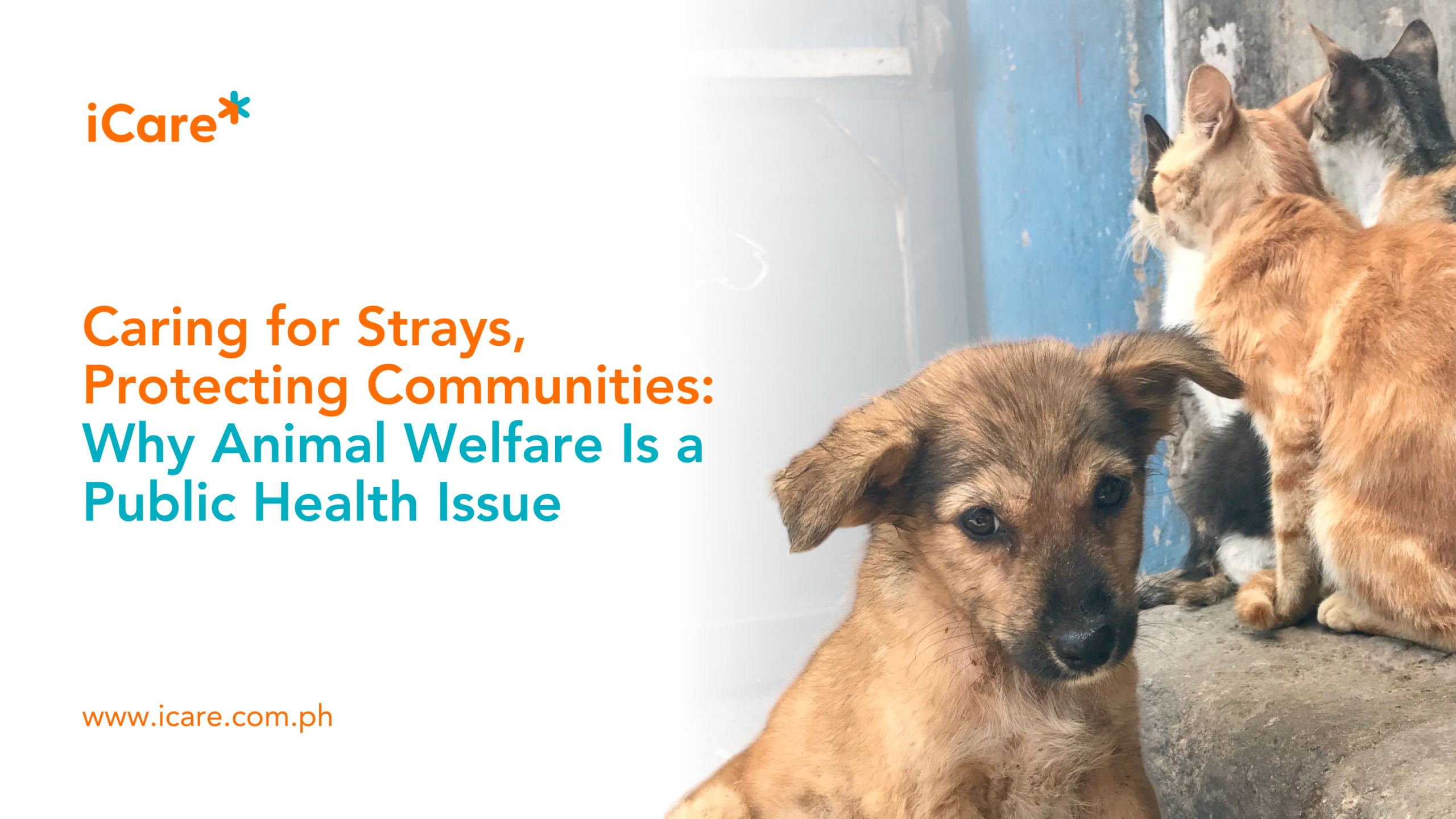
July 30, 2026 Caring for Strays, Protecting Communities: Why Animal Welfare Is a Public Health Issue
Responsible care for community animals must extend beyond feeding. It requires vaccination, humane population management, accessible animal bite clinics and healthcare coverage that allows people to seek treatment without delay.
A bowl of water left outside a gate, a packet of food placed near a vacant lot or a temporary shelter built for a community cat can be an ordinary expression of Filipino compassion. Across neighborhoods, offices, schools and commercial districts, people care for animals that have no clearly identifiable owner.
These acts matter. They can keep an animal alive, reduce suffering and create pathways towards rescue or adoption. But feeding a stray dog or cat is not, by itself, a complete animal welfare intervention. Without vaccination, sterilization, veterinary assessment and coordination with local authorities or animal welfare organizations, individual kindness may remain disconnected from the broader systems needed to protect both animals and people.
This is where stray animal care becomes a public health issue.
The question should not be whether communities must choose between protecting animals and protecting people. That is a false choice. The more useful question is how humane animal management, rabies prevention, healthcare access and financial protection can operate as parts of the same system.
Rabies changes the consequences of an ordinary encounter
Most interactions with community dogs and cats do not result in injury. However, even a minor scratch or bite requires serious attention because the vaccination and health status of a free-roaming animal may be unknown.
The World Health Organization describes rabies as a vaccine-preventable zoonotic disease that affects the central nervous system. Dogs are responsible for up to 99 per cent of human rabies transmission worldwide. Once clinical symptoms appear, the disease is virtually always fatal. Prompt post-exposure prophylaxis, which may include wound washing, vaccination and rabies immunoglobulin, can prevent the virus from reaching the central nervous system.
The Philippine experience shows why prevention cannot be treated as a minor concern. In March 2025, PhilHealth cited Department of Health data showing that all 426 recorded human rabies cases in the country in 2024 resulted in death. Of these cases, 193 were associated with bites from domestic pets, and more than half of those animals had an unknown vaccination status.
The figures also challenge the assumption that rabies is exclusively a stray animal problem. Owned animals can present a risk when they are unvaccinated, allowed to roam freely or not properly observed following a biting incident. The central issue is therefore not whether an animal lives inside a household or on the street. It is whether vaccination, responsible ownership, surveillance and timely human treatment are in place.
Stray animals are often the most visible part of the problem, but they are also among its most vulnerable participants. Many are abandoned pets or the offspring of unsterilized animals. Treating them purely as nuisances does little to address the conditions that allow uncontrolled populations and disease risks to persist.
Animal welfare and disease prevention belong to the same strategy
Effective rabies control follows the principle of One Health, which recognizes that human health, animal health and the environment are interconnected.
WHO identifies three proven elements of rabies prevention: public awareness, prompt access to post-exposure prophylaxis and mass dog vaccination. It describes dog vaccination as a cost-effective means of preventing human deaths because it interrupts transmission at its source. WHO also states that appropriate wound management and prompt access to quality-assured post-exposure prophylaxis are almost 100 per cent effective in preventing human rabies deaths.
Vaccination coverage is critical. WHO guidance indicates that vaccination programs generally need to reach more than 70 per cent of the dog population in at-risk areas to interrupt rabies transmission. Reaching free-roaming animals is one of the practical difficulties faced by vaccination programs, which is why humane dog population management and coordinated community action are necessary.
Importantly, WHO does not support the indiscriminate killing of free-roaming dogs as an effective rabies-control strategy. Its guidance states that culling free-roaming dogs does not control rabies. Vaccination, bite prevention, responsible ownership and accessible treatment are more sustainable interventions.
This changes how communities should think about caring for strays. Compassion should not stop at feeding. Responsible community animal care may include coordinating with city or municipal veterinary offices, supporting vaccination and spay or neuter activities, helping animals enter foster or adoption programs, reporting suspected illness and avoiding untrained handling of frightened or injured animals.
Food can address immediate hunger. It cannot provide immunity against rabies, prevent reproduction, treat disease or establish accountability after a bite. A humane program must therefore connect feeding with veterinary care and population management rather than presenting them as separate activities.
Philippine law already links ownership, welfare and public safety
The Philippines has a legal framework that recognizes the shared responsibilities behind rabies prevention.
Republic Act No. 9482, or the Anti-Rabies Act of 2007, established a national program involving the Department of Agriculture, Department of Health, Department of the Interior and Local Government, Department of Education and local government units, with support from non-government and people’s organizations.
The law requires dog owners to have their animals regularly vaccinated and registered, maintain control over them, prevent them from roaming in public without a leash, provide adequate food and shelter, report biting incidents within 24 hours and place the animal under veterinary observation. It also requires owners to assist bite victims and shoulder medical and related expenses arising from the injury.
Local governments have corresponding responsibilities, including dog registration and vaccination, field control and impounding, information campaigns and the establishment or shared operation of animal pounds. The law anticipates adoption with the assistance of animal welfare organizations when feasible, subject to animal welfare requirements.
The Animal Welfare Act, as amended by Republic Act No. 10631, also makes it unlawful for a person who has custody of an animal to abandon it. This is an important policy point because unmanaged animal populations cannot be addressed solely by removing animals already on the street. Prevention must include accountability for abandonment, uncontrolled breeding and irresponsible ownership.
The implementation gap, rather than the absence of policy, is the more difficult issue. Vaccination programs, animal pounds, veterinary services, sterilization initiatives and public education depend heavily on local capacity. Some cities and municipalities have stronger systems than others. This creates uneven conditions for both animal welfare and human healthcare access.
After a bite, time and correct information matter
A person who is bitten or scratched should not wait for the animal to show symptoms before seeking professional assessment.
WHO recommends immediately washing the wound thoroughly with soap and water for at least 15 minutes. Category II exposures, such as minor scratches or abrasions without bleeding, require immediate vaccination. Category III exposures, including bites that penetrate the skin or saliva contact with broken skin or mucous membranes, require vaccination and rabies immunoglobulin or another recommended antibody product when indicated.
This is why animal bite treatment centers and animal bite clinics occupy an important place in the Philippine healthcare provider network. They are designed to assess exposure, administer post-exposure prophylaxis, manage wounds and guide patients through the required vaccination schedule. The Department of Health has repeatedly advised the public to use certified animal bite treatment centers or animal bite centers to ensure that treatment follows recognized standards.
Knowing where to go is not a minor administrative matter. A frightened employee or parent may instinctively proceed to the nearest hospital emergency room, only to discover that the facility does not administer the required vaccine, that the service is provided through an outpatient clinic or that the chosen healthcare plan follows a different authorization process.
The best provider network is therefore not simply the one with the largest number of hospitals. For conditions such as animal bites, accessibility depends on whether the network includes appropriately equipped clinics, whether vaccine availability and operating hours are updated, and whether customer service teams can quickly direct members to the correct healthcare provider.
The financial burden can discourage prompt treatment
Rabies treatment is preventable healthcare, but it is not necessarily cost-free.
PhilHealth’s Animal Bite Treatment Package provides P5,850 for eligible services delivered through accredited animal bite treatment package providers. The benefit includes rabies vaccines, rabies immunoglobulin when required, local wound care, tetanus protection, antibiotics and necessary medical supplies. PhilHealth reported in March 2025 that the package was available through more than 700 accredited providers, while its current online directory continues to publish updated lists of participating facilities.
The package is an important layer of national health insurance protection. However, patients still need to confirm that the facility is accredited, that the services required are included and that they follow the complete treatment schedule prescribed by the healthcare professional.
Private treatment prices vary by facility, vaccine type, exposure category and whether rabies immunoglobulin is necessary. There is no single authoritative national retail price that applies to every public or private clinic. Publishing an assumed cost would therefore be misleading.
HMO coverage also varies by contract. Some corporate plans include animal bite treatment through accredited outpatient facilities. Some prepaid emergency health plans may exclude animal bites or may not cover treatment obtained from a hospital emergency room. Employees should not assume that all products sold as health insurance, HMO or emergency coverage provide the same benefit.
This distinction matters in a country where households continue to carry a significant share of healthcare costs. The Philippine Statistics Authority reported that total health expenditure reached P1.87 trillion in 2025, an increase of 15.1 per cent from 2024. Household out-of-pocket payments accounted for 41.2 per cent of current health expenditure.
At the same time, the Insurance Commission reported that Philippine HMOs delivered P74.64 billion in healthcare benefits and claims in 2025. Rising utilization and healthcare spending make it increasingly important for HMOs and employers to direct members to the appropriate level of care while ensuring that benefit limitations are communicated before an urgent need arises.
iCare, for example, directs members whose plans cover animal bites to accredited outpatient animal bite centers rather than automatically routing every case through a hospital emergency room. It has partnered with approximately 300 animal bite centers offering cashless treatment for eligible members, although actual access and coverage remain subject to the member’s specific plan.
The broader lesson is not about one HMO. It is that managed healthcare works best when members know which facility to use, what their coverage includes and whom to contact before financial uncertainty causes treatment delay.
Why employers should pay attention
Animal bites may appear peripheral to corporate health strategy, but they illustrate several recurring weaknesses in employee benefits programs.
The first is benefit literacy. Employees may have comprehensive medical coverage and still pay unnecessarily out of pocket because they do not know which clinic is accredited, whether a letter of authorization is required or whether their HMO and PhilHealth benefits can be coordinated.
The second is provider accessibility. Large employers and SMEs often review hospital networks during procurement, but may pay less attention to primary care clinics, diagnostic facilities, mental health providers, and animal bite centers. A big network has limited value when the required service is unavailable near an employee’s home or worksite.
The third is occupational risk. Delivery personnel, security staff, utility workers, field sales teams, veterinary personnel, community workers and employees regularly entering residential areas may face greater contact with free-roaming animals. WHO recommends pre-exposure vaccination for certain high-risk occupations and activities, although it does not replace the need for post-exposure treatment following a bite. Employers should assess these risks through occupational health rather than relying on employees to manage them individually.
HR and Human Resources leaders can respond by including animal bite protocols in workplace health communications, publishing verified clinic directories, clarifying HMO and PhilHealth procedures and ensuring that supervisors do not discourage employees from seeking immediate care. Companies can also direct corporate social responsibility programs towards humane vaccination, sterilization and adoption partnerships rather than one-time feeding activities alone.
Such initiatives should not become substitutes for government responsibility. They can, however, strengthen collaboration among businesses, local veterinary offices, healthcare providers, animal welfare organizations and communities.
Compassion requires infrastructure
A society’s treatment of stray animals says something about its willingness to protect vulnerable life. Its response to animal bites says something equally important about healthcare accessibility, public education and financial protection.
The two responsibilities are not in conflict.
Communities can feed animals while supporting vaccination. Local governments can manage free-roaming populations without resorting to indiscriminate cruelty. Employers can encourage volunteerism while educating workers about bite prevention. HMOs can manage healthcare costs while directing members towards timely and appropriate treatment. Healthcare providers can protect human life without portraying every community animal as a threat.
The most effective approach is neither fear nor sentimentality. It is organized compassion supported by public health systems.
Caring for a stray animal should mean more than helping it survive another day. It should mean working towards a community in which animals are vaccinated and humanely managed, owners are accountable, bite victims know where to seek care and the cost of treatment does not become a reason to wait.
That is not only animal welfare. It is preventive care, healthcare access, and responsible community health in practice.
Sources and References
- World Health Organization. “Rabies.” 5 June 2024. Available at: https://www.who.int/news-room/fact-sheets/detail/rabies
- World Health Organization. “Human Rabies Prevention and Management.” Available at: https://www.who.int/activities/human-rabies-prevention-and-management
- World Health Organization. “Veterinary Vaccines for Rabies.” Available at: https://www.who.int/teams/control-of-neglected-tropical-diseases/rabies/vaccinations-and-immunization/veterinary-vaccines
- Republic of the Philippines. Republic Act No. 9482, Anti-Rabies Act of 2007. 25 May 2007. Available at: https://lawphil.net/statutes/repacts/ra2007/ra_9482_2007.html
- Republic of the Philippines. Republic Act No. 10631, An Act Amending Certain Sections of Republic Act No. 8485. 3 October 2013. Available at: https://lawphil.net/statutes/repacts/ra2013/ra_10631_2013.html
- Philippine Health Insurance Corporation. “PhilHealth Animal Bite Package Covers PHP 5,850 for Services Against Highly Fatal Rabies.” 18 March 2025. Available at: https://www.philhealth.gov.ph/news/up/article/2025/news_67d9204d37171.php
- Philippine Health Insurance Corporation. “Benefits: Animal Bite Treatment Package.” Available at: https://www.philhealth.gov.ph/benefits/
- Philippine Health Insurance Corporation. “List of Accredited Animal Bite Package Providers for CY 2026.” Updated 31 May 2026. Available at: https://www.philhealth.gov.ph/partners/providers/facilities/accredited/ABPP_053126.pdf
- Philippine Statistics Authority. “Government Contributes 46.5 Percent to the Country’s Current Health Spending in 2025.” 18 June 2026. Available at: https://psa.gov.ph/content/government-contributes-465-percent-countrys-current-health-spending-2025
- Insurance Commission of the Philippines. “HMO Industry Sustains Growth and Delivers P74.64 Billion in Benefits in 2025.” 19 February 2026. Available at: https://www.insurance.gov.ph/hmo-industry-sustains-growth-and-delivers-p74-64-billion-in-benefits-in-2025/
- Department of Health Bicol Center for Health Development. “DOH Bicol CHD Urges Public to Avail Anti-Rabies Shots in Certified ABTCs and ABCs.” Available at: https://bicol.doh.gov.ph/news-releases/doh-bicol-chd-urges-public-to-avail-anti-rabies-shots-in-certified-abtcs-abcs/
- iCare HMO Philippines. “Proper Care for Animal Bites and Scratches.” Available at: https://icare.com.ph/animal-bites-and-scratches/
- iCare HMO Philippines. “Accredited Animal Bite Centers.” Available at: https://icare.com.ph/accredited-animal-bite-centers/
