
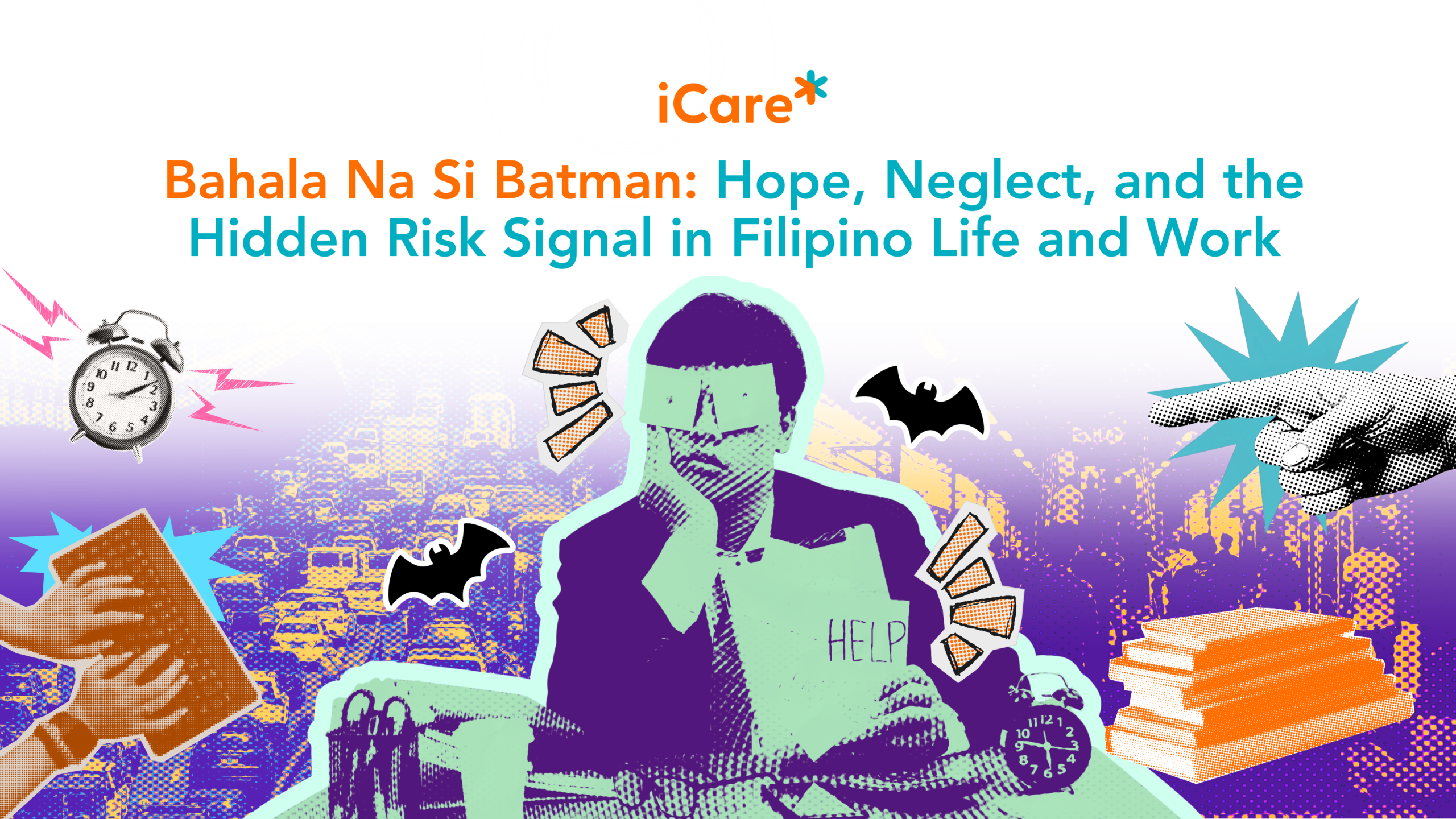
August 20, 2026 Bahala Na Si Batman: Hope, Neglect, and the Hidden Risk Signal in Filipino Life and Work
The Filipino phrase is often treated as humor, fatalism, or resilience. For employers, healthcare leaders, and policymakers, it should be read more carefully: as a cultural signal about how people cope when systems feel uncertain.
“Bahala na si Batman” is usually said with a laugh. It is casual, recognizable, and distinctly Filipino in its fusion of old cultural instinct and imported pop culture. In ordinary conversation, it often means leaving the outcome to fate, to luck, or to a fictional rescuer who arrives when ordinary planning has run out. Philippine popular writing has described the phrase as an extension of “bahala na,” with Batman inserted partly for humor and alliteration, though the precise origin remains speculative rather than firmly documented.
Yet the phrase deserves more serious attention than it usually receives. In boardrooms, hospitals, clinics, call centers, factories, government offices, and small businesses across the Philippines, its spirit appears whenever people push through uncertainty without enough support. A worker postpones a check-up because the family budget is tight. An SME owner delays employee benefits because cash flow is uncertain. An HR team reacts to health claims only after hospitalization. A manager praises resilience while ignoring burnout. In each case, “Bahala na si Batman” may sound like hope. It may also reveal neglect.
Filipino psychology cautions against reducing “bahala na” to simple fatalism. Alfredo V. Lagmay’s influential work in the Philippine Journal of Psychology argued that bahala na does not necessarily mean submission or withdrawal. His analysis framed it as a functional response to uncertainty, marked by acceptance of the situation, tolerance of ambiguity, and openness to improvisation. A later study by Ma. Ligaya Menguito and Mendiola Teng-Calleja likewise examined bahala na in relation to courage, hope, optimism, self-efficacy, and the search for the sacred, finding that it could involve rational assessment of resources and purposeful action rather than passive surrender.
This distinction matters to business and healthcare leaders. The question is not whether “Bahala na si Batman” is good or bad. The more useful question is what happens after it is said. If it becomes a bridge to action, it can signify hope. If it becomes a substitute for preparation, investment, preventive care, and accountable leadership, it becomes neglect.
The cultural logic of hope under constraint
Many societies have phrases for uncertainty. What makes “Bahala na si Batman” distinctive is its mixture of resignation, humor, improvisation, and social intelligence. It does not merely say, “nothing can be done.” More often, it says, “the situation is uncertain, but we will face it anyway.” In a country where families, workers, and businesses have long learned to navigate typhoons, inflation, traffic, fragmented services, and uneven public systems, this kind of humour can be a survival mechanism.
Sikolohiyang Pilipino, or Filipino psychology, emerged partly as a response to interpretations of Filipino behavior that relied too heavily on foreign categories. Pe-Pua and Protacio-Marcelino describe Sikolohiyang Pilipino as anchored on Filipino thought and experience as understood from a Filipino perspective, a corrective to analyses that interpreted local behavior without sufficient cultural grounding. Within that tradition, bahala na can be read less as a defect and more as a form of agency under incomplete control.
For employers, this has practical implications. Filipino workers often demonstrate extraordinary adaptability. They commute through unreliable transport systems, support extended families, absorb changing workloads, and continue working through personal or financial pressure. A simplistic reading would call this resilience. A more responsible reading would ask whether the organization is relying too much on that resilience because it has underinvested in systems, benefits, staffing, occupational health, and management discipline.
This is where the phrase becomes an executive concern. A culture that celebrates grit without building support systems can quietly transfer institutional risk to individuals. Employees are expected to cope. Families are expected to absorb costs. HR teams are expected to solve structural problems through goodwill. In healthcare, this can mean delayed consultations, unmanaged chronic disease, avoidable hospital admissions, and higher long-term costs.
When cultural resilience meets healthcare reality
The Philippines has made important policy commitments to health access. The Universal Health Care Act seeks to guarantee equitable access to quality and affordable healthcare goods and services and protect Filipinos against financial risk. It also recognizes promotive, preventive, curative, rehabilitative, and palliative services as part of a comprehensive health model. But policy intent and household experience do not always move at the same speed.
Health financing remains a central pressure point. The Philippine Statistics Authority reported that in 2025, government and compulsory contributory schemes accounted for 46.5 percent of Current Health Expenditure, while household out-of-pocket payments still accounted for 41.2 percent. The same PSA page notes that household out-of-pocket payments accounted for 44.4 percent of Current Health Expenditure in 2023. These figures explain why many Filipinos still experience healthcare as a financial decision before it becomes a clinical one.
For employers, the issue is compounded by medical inflation. WTW’s 2026 Global Medical Trends data projected that healthcare benefit costs in the Philippines would rise by 16.1 percent in 2026, after 17.0 percent in 2024 and 14.3 percent in 2025. The same report projected Asia Pacific medical cost increases at 14.0 percent in 2026. Mercer Marsh Benefits also warned that employer-provided health plans face pressure from double-digit medical trends across most markets, driven by utilization, higher incidence of health conditions, and advanced technologies.
This is the business version of “Bahala na si Batman.” When companies treat healthcare benefits as a compliance item or a recruitment perk rather than a risk-management system, they leave employees and balance sheets exposed. The result is not only higher claims. It is uncertainty in workforce wellbeing, productivity, employee experience, retention, and trust.
The cost of waiting
Preventive care is where cultural tension becomes most visible. Many Filipinos seek care only when symptoms are already disruptive. This is not simply a matter of attitude. It reflects cost, time, access, fear, stigma, transport, clinic availability, and the difficulty of navigating healthcare systems. When preventive care is inconvenient or unaffordable, “bahala na” becomes a rational response to constraint.
The disease burden strengthens the case for earlier intervention. PSA provisional data for 2024 showed that ischaemic heart diseases were the leading cause of death in the Philippines, with 128,889 cases or 19.2 percent of total deaths. Neoplasms ranked second with 74,182 deaths, cerebrovascular diseases third with 65,866 deaths, pneumonia fourth with 44,986 deaths, and diabetes mellitus fifth with 42,153 deaths. These are not conditions that can be addressed only through emergency care. They require screening, primary care, lifestyle support, chronic disease management, medication adherence, and sustained patient navigation.
The workplace is an important site for this shift. Large employers and leading companies can use HMO coverage, occupational health programs, annual physical examinations, telemedicine, provider network design, mental health support, and claims analytics to move from reactive care to managed healthcare. SMEs and small and medium enterprises need models that are affordable enough to adopt but structured enough to provide meaningful healthcare access. The challenge is not merely choosing the “best” HMO in the Philippines. It is designing employee benefits that help people act before illness becomes expensive.
Mental health and the limits of silent endurance
The same logic applies to mental health. The International Labor Organization notes that all workers have the right to safe and healthy working environments where physical and mental health are protected and promoted. It also cites the global loss of 12 billion working days every year due to depression and anxiety. (International Labour Organization) In the Philippines, Republic Act No. 11036, or the Mental Health Act, recognizes the right of Filipinos to mental health and requires integration of mental health strategies in educational institutions, workplaces, and communities.
The policy architecture is developing. In 2023, the DOH and WHO launched the Philippine Council for Mental Health Strategic Framework 2024 to 2028 to guide mental health policies, programS and services. The same WHO report noted that since the passage of the Mental Health Act, the Philippines had scaled up mental health access sites and medicines, and that 78,449 private establishments had mental health workplace policies. These are significant developments, but workplace culture remains decisive.
In many organizations, “kaya pa” still functions as an informal performance standard. Employees may hesitate to seek help because they fear stigma, weak confidentiality, or the perception that mental health concerns are personal weaknesses rather than legitimate health needs. In this setting, “Bahala na si Batman” can become a mask. It allows people to joke about pressure while concealing exhaustion. For HR and human resources leaders, the phrase should prompt inquiry rather than dismissal: What pressure is being normalized? What support is absent? What risks are becoming invisible?
The Philippine employer’s choice
The Philippines is an economy of both large employers and SMEs. A BSP Research Academy presentation using PSA’s 2023 List of Establishments reported that MSMEs represented 99.6 percent of all business establishments and generated 67.0 percent of total employment. This means the employee benefits conversation cannot be designed only for large corporations. It must also work for smaller employers that face tighter margins, less administrative capacity, and more volatile cash flow.
For large employers, the strategic question is how to convert health insurance from a claims payment mechanism into a workforce health platform. That means stronger preventive care, better provider navigation, faster customer service, smarter use of clinics and hospitals, and more deliberate management of chronic conditions. For SMEs, the priority is access to affordable, understandable, and trusted health plans that do not require a large HR department to administer.
This is where the HMO industry can play a consequential role. A provider network is not just a directory of hospitals and clinics. It is an infrastructure for trust. Customer service is not just a call center function. It is part of healthcare access. Telemedicine is not merely a digital feature. It can reduce friction for employees who would otherwise postpone care. Managed healthcare, at its best, turns uncertainty into pathways.
iCare has a blend of Singaporean efficiency and Filipino care, serving more than one million members nationwide. Its Telemed7 initiative, offered through Viber, is presented as part of its nationwide network and a way to make doctor access more convenient for employees and members. These examples are relevant not because they make iCare the center of the story, but because they illustrate the direction the market must take: from passive coverage to active care navigation.
Hope should not be outsourced to superheroes
The social meaning of “Bahala na si Batman” lies in its ambiguity. It can be playful courage. It can be spiritual surrender. It can be humor under pressure. It can also be a warning that people no longer believe the system will respond in time.
Leaders should resist two errors. The first is to look down on the phrase as proof of Filipino fatalism. That misses the agency, humor, and improvisational intelligence embedded in the culture. The second is to romanticize it as resilience. That allows companies, institutions, and policymakers to avoid responsibility.
The better interpretation is more demanding. “Bahala na si Batman” is acceptable as a momentary expression of courage. It is unacceptable as a healthcare strategy, a benefits philosophy, a public policy posture, or a management style. Hope becomes productive when it is matched by systems that help people act. Neglect begins when leaders admire endurance more than they build support.
For CEOs, CHROs, CFOs, HR leaders, healthcare providers, insurers, and policymakers, the task is clear. Build workplaces where preventive care is easier than postponement. Design HMO and health insurance programs that manage medical inflation without hollowing out benefits. Strengthen provider networks, so hospitals, clinics, doctors, and telemedicine services are easier to navigate. Treat mental health as part of workplace health, not an afterthought. Make employee benefits credible for both large employers and SMEs.
A society should be allowed to its jokes. But no worker’s health, no family’s financial stability, and no company’s workforce wellbeing should depend on Batman arriving at the last moment.
Sources and References
Alfredo V. Lagmay. “Bahala Na.” Philippine Journal of Psychology. Available at: https://pssc.org.ph/wp-content/pssc-archives/Works/Alfredo%20Lagmay/Bahala%20Na%20%28PJP%29.pdf
Ma. Ligaya Menguito and Mendiola Teng-Calleja. “Bahala Na as an Expression of the Filipino’s Courage, Hope, Optimism, Self-Efficacy, and Search for the Sacred.” Philippine Journal of Psychology, 2010. Available at: https://archium.ateneo.edu/gsb-pubs/34/
Rogelia Pe-Pua and Elizabeth Protacio-Marcelino. “Sikolohiyang Pilipino: A Legacy of Virgilio G. Enriquez.” Asian Journal of Social Psychology, 2000. Available at: https://www.indigenouspsych.org/Members/Pe-Pua%2C%20Rogelia/PePua_Marcelino_2000.pdf
Philstar. “Wordplay: A geek’s guide to origins.” Available at: https://www.philstar.com/lifestyle/young-star/2011/08/05/713123/wordplay-geeks-guide-origins
Republic Act No. 11223, Universal Health Care Act. Supreme Court E-Library. Available at: https://elibrary.judiciary.gov.ph/thebookshelf/showdocs/2/86448
Philippine Statistics Authority. “Government Contributes 46.5 Percent to the Country’s Current Health Spending in 2025.” Available at: https://psa.gov.ph/content/government-contributes-465-percent-countrys-current-health-spending-2025
WTW. “Double-digit medical cost increases projected to persist into 2026 and beyond.” Available at: https://www.wtwco.com/en-sg/news/2025/11/double-digit-medical-cost-increases-projected-to-persist-into-2026-and-beyond-in-singapore
Mercer Marsh Benefits. “Health Trends 2026: Balancing cost control with benefits optimization.” Available at: https://www.mercer.com/insights/total-rewards/employee-benefits-optimization/mmb-health-trends/
Philippine Statistics Authority. “2024 Causes of Death in the Philippines, Provisional as of 30 June 2025.” Available at: https://psa.gov.ph/content/2024-causes-death-philippines-provisional-30-june-2025
International Labour Organization. “Psychosocial risks and Mental Health at Work.” Available at: https://www.ilo.org/topics-and-sectors/safety-and-health-work/psychosocial-risks-and-mental-health-work
Republic Act No. 11036, Mental Health Act. Supreme Court E-Library. Available at: https://elibrary.judiciary.gov.ph/thebookshelf/showdocs/2/83255
World Health Organization Philippines and Department of Health. “DOH, WHO launch Philippine Council for Mental Health Strategic Framework 2024 to 2028.” Available at: https://www.who.int/philippines/news/detail/12-10-2023-doh–who-launch-philippine-council-for-mental-health-strategic-framework-2024-2028
Bangko Sentral ng Pilipinas Research Academy, using PSA 2023 List of Establishments. “MSMEs: Backbone of the Philippine economy.” Available at: https://www.bsp.gov.ph/Inclusive%20Finance/EFLP/EFLP_MSMEs_01a.pdf
iCare HMO Philippines. “Affordable HMO in the Philippines.” Available at: https://icare.com.ph/
iCare HMO Philippines. “iCare HMO Marks 35 Years, Moves Forward as an Independent Healthcare Organization.” Available at: https://icare.com.ph/2026/01/19/icare-hmo-marks-35-years-moves-forward-as-an-independent-healthcare-organization/
iCare HMO Philippines. “iCare Brings Healthcare to Viber with Telemed7: Doctor in 7 Minutes.” Available at: https://icare.com.ph/2025/09/12/icare-brings-healthcare-to-viber-with-telemed7-doctor-in-7-minutes/
