

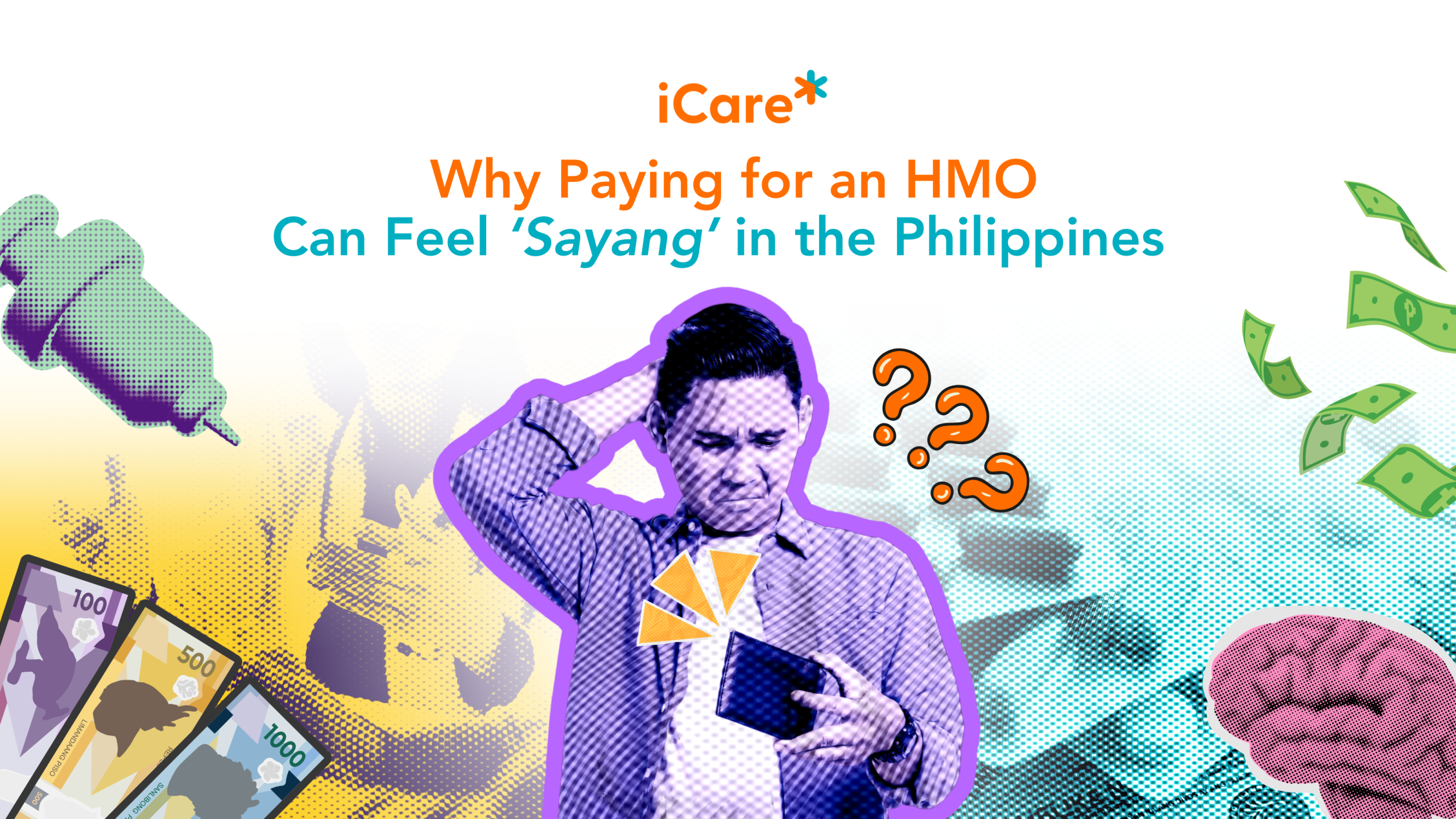
September 14, 2026 Why Paying for an HMO Can Feel ‘Sayang’ in the Philippines
We can understand the logic of buying a spare tire we hope never to use. We can spend on small comforts because their value is immediate. Health protection is harder to appreciate because its value often becomes visible only when something goes wrong.
There is a particular kind of purchase that can feel difficult to justify when nothing bad has happened yet.
A cup of iced coffee gives you something immediately. You drink it, enjoy it, and know exactly what you paid for. A new pair of shoes enters your closet. A streaming subscription gives you something to watch tonight. Even a spare tire, although ideally unused, is physically sitting in the trunk where you can see it.
Then there is an HMO.
You pay for healthcare access for a defined period. Maybe you barely see a doctor. Maybe you do not need to be admitted to a hospital. The year ends without a major health emergency, and a familiar thought can creep in: Sayang. Hindi ko naman nagamit.
It is an understandable reaction. It is also a revealing one.
The sayang mindset around health protection reflects a basic tension in how people assign value. We easily recognize the usefulness of something we consume immediately. We have a harder time valuing protection against an uncertain future expense, particularly when paying for that protection reduces the money available today.
That does not mean Filipinos are uniquely shortsighted, nor is there national survey evidence showing that Filipinos broadly consider HMOs a waste of money. The phrase is better treated as a familiar cultural observation than a measurable national attitude. What research does show is that decisions about health coverage are influenced by far more than people’s objective exposure to medical costs.
A 2022 study in the Journal of Risk and Uncertainty used data from a nationwide survey of Filipino households to examine willingness to pay for health insurance. Among uninsured households in the study, average stated willingness to pay was lower than both the estimated actuarially fair price and the subsidized price at which public insurance was available. Importantly, this could not simply be explained by people underestimating their possible medical expenses. Their expected medical spending was, on average, higher than the subsidized insurance price. The researchers found that risk attitudes, along with other factors such as liquidity constraints, understanding of insurance, trust, and perceptions of healthcare quality, could help explain low willingness to pay. The study concerned health insurance rather than commercial HMO plans, so its findings should not be directly applied to HMO purchasing behavior, but it demonstrates how complicated the decision to pay today for future health protection can be.
That makes sayang more interesting than simple reluctance to spend.
It is partly a question of what counts as getting your money’s worth.
Why coffee feels different from healthcare protection
The iced coffee comparison works because the transactions operate on different timelines.
Spend money on coffee and the exchange is completed almost immediately. Money leaves your wallet, and something pleasurable arrives in your hand. There is little uncertainty about whether you received value.
Health protection asks you to make a different calculation. You exchange certain money today for access to benefits that you may need later, in circumstances you would rather avoid entirely.
The point is not that Filipinos should stop buying coffee and use every discretionary peso for healthcare. Small pleasures have genuine value, and reducing personal finance to a morality test over coffee misses the larger issue.
The comparison matters because it demonstrates how differently people experience a visible present benefit and an invisible future one.
A spare tire provides an even better analogy. Nobody buys one hoping for a flat. If the tire remains untouched for years, we do not normally conclude that purchasing it was foolish. Its purpose was to be available when an uncertain event made it necessary.
An HMO works differently from a spare tire, but the underlying principle of preparation is similar.
Under Executive Order No. 192, which transferred regulatory supervision of HMOs to the Insurance Commission, an HMO is defined as an organization that provides or arranges pre-agreed healthcare services for enrolled members in exchange for a fixed prepaid fee over a specified period. It is therefore not simply a savings account into which a member deposits money and expects the same amount back.
The prepaid fee purchases access to the services defined by the plan, subject to its benefit limits, exclusions, eligibility rules, provider network, and other terms.
This distinction changes the meaning of sulit.
If the only measure of value is whether the member receives medical services worth more than the membership fee, then getting sick enough to generate a large claim becomes the easiest way to make the plan feel worthwhile. That is a strange standard for a healthcare product.
A healthier outcome may be paying for protection and never needing its most expensive benefits.
The cost we notice versus the risk we do not
Healthcare expenses are particularly difficult to plan for because they are uneven.
Some years may involve little more than routine consultations and medicines. Others can bring diagnostic tests, emergency treatment, specialist care, hospitalization, or continuing management of a chronic condition.
At the national level, the financial burden remains substantial.
The Philippine Statistics Authority reported that households directly funded 41.2 percent of the country’s current health expenditure in 2025 through out-of-pocket payments. Government schemes and compulsory contributory healthcare financing accounted for 46.5 percent, while voluntary healthcare payment schemes accounted for 12.3 percent. Total health expenditure reached P1.87 trillion, and current health spending per person rose to P15,223.
These are national aggregates. They do not tell an individual Filipino how much a future illness will cost, and they should not be used to claim that everyone needs the same private health plan.
They do show why financial protection remains central to healthcare policy.
WHO describes financial protection as a core objective of universal health coverage. Heavy reliance on payments made at the point of care can create financial hardship and can discourage people from seeking needed healthcare in the first place. Prepayment and pooling are among the mechanisms health systems use to distribute financial risk more broadly rather than leaving each household to absorb costs only when illness occurs.
An HMO operates within a much larger Philippine health-financing system that also includes government funding, PhilHealth, private insurance, employer benefits, and household spending. It does not eliminate every medical expense, nor should it be portrayed as a substitute for adequate public healthcare.
Its role is more specific: within the terms of a particular plan, it can arrange access to designated healthcare services before a member has to negotiate every consultation or hospital encounter entirely on their own.
That is a different proposition from saving money and hoping the savings will be sufficient.
An unused HMO is not necessarily a wasted HMO
This is where the language of sayang deserves closer examination.
Suppose someone pays for an HMO and experiences no hospitalization that year. Was the membership wasted?
The only defensible answer is: it depends.
It may have provided access to consultations, preventive services, laboratory tests, telemedicine, outpatient care, or other benefits that the member could have used depending on the plan. It may also have provided financial protection that fortunately was never tested by a serious illness.
On the other hand, a plan can genuinely offer poor value for a particular person. A provider network may be inconvenient. Benefits may duplicate coverage already available through an employer. Important conditions or procedures may be excluded. Benefit limits may not match the individual’s likely needs. The membership fee may be unaffordable relative to other financial priorities.
Buying an HMO simply because one is available is not automatically a wise financial decision.
The more useful question is not “Magagamit ko ba lahat?”
It is “Does this plan give me healthcare access and financial protection that make sense for my circumstances?”
That requires reading beyond the price.
A cheaper HMO is not necessarily the most affordable option if its accessible hospitals and clinics are far from where the member lives. A plan with a big provider network is useful only if the relevant healthcare providers are realistically available to the member. A high benefit limit does not tell the whole story if the services a person expects to use are excluded.
The best HMO for one person can therefore be unsuitable for another.
The phrase best HMO in the Philippines may work well as a search term, but it is not a meaningful healthcare conclusion without asking: best for whom, for which health needs, in which location, at what cost, and under what terms?
There is another reason “sayang” persists: health competes with everything else
It is easy to tell people to prioritize healthcare when looking at household finances from the outside.
It is harder when the same salary needs to cover rent, food, transportation, electricity, education, family support, debt, emergency savings, and the ordinary pleasures that make work feel worth doing.
This is why affordability cannot be dismissed as poor financial discipline.
Research involving Filipino households has shown that willingness to pay for health insurance can remain low even when people recognize substantial medical expenditure risk. A separate study published in the Journal of Health Economics in 2022 examined a nationwide Philippine experiment involving incentives for health insurance enrollment. A temporary premium subsidy produced a modest but persistent increase in enrollment, while hands-on application assistance produced a much larger initial effect. The findings showed that price mattered, but administrative friction and willingness to pay mattered as well.
Again, the study examined public health insurance rather than commercial HMO products. The broader lesson is that healthcare coverage decisions cannot be reduced to awareness alone.
People may understand that protection is useful and still struggle to prioritize it.
For HMO providers, employers, and policymakers, this places responsibility on the system as well as the consumer. Healthcare plans must be understandable. Benefits need to be transparent. Provider networks should be usable. Customer service should help people navigate care rather than add another barrier to it.
Financial protection loses credibility when people cannot understand what they are paying for.
Rising healthcare costs make the calculation harder
The sayang question is also appearing in a healthcare market facing significant cost pressure.
WTW’s 2026 Global Medical Trends Survey projects a gross medical trend rate of 16.1 percent for the Philippines in 2026, compared with an Asia-Pacific average of 14 percent. The estimate comes from an industry survey of insurers and brokers and is not an official Philippine inflation statistic. Medical trend also measures more than changes in the sticker price of healthcare. It can incorporate utilization patterns, treatment choices, new technologies, pharmaceuticals, and other drivers of medical claims.
That distinction matters because discussions of medical inflation are often oversimplified.
Still, the direction presents a challenge for both households and employers. As healthcare claims become more expensive, the price of providing health benefits also becomes harder to manage.
For large employers and leading companies, the issue is not merely whether to offer an HMO. Finance leaders, HR, and Human Resources teams increasingly have to balance employee benefits with healthcare-cost sustainability. For SMEs and small and medium enterprises, the challenge can be even sharper because health-benefit budgets have less room to absorb large fluctuations.
Simply shifting more costs to employees may control an employer’s immediate budget while weakening the financial protection the benefit was designed to provide. At the same time, continuously increasing coverage without examining utilization, provider arrangements, preventive care, chronic disease management, and plan design can make corporate health programs harder to sustain.
A credible workplace health strategy therefore sits between those extremes.
It treats an HMO as part of workforce wellbeing and employee experience while acknowledging that the economics of managed healthcare still matter.
The HMO industry is already paying for a great deal of care
Another way to test the idea that HMO fees simply disappear when people pay them is to look at what the sector actually finances.
According to the Insurance Commission, HMOs in the Philippines disbursed P74.64 billion in healthcare benefits and claims on behalf of members in 2025. The Commission’s 2025 industry figures also showed continued growth in HMO membership fees and market activity.
That does not mean every member received P74.64 billion divided evenly among them. Health financing does not work that way.
Some people require substantially more care than others in a particular year. That variation is precisely why prepayment matters.
The person who rarely uses their HMO and the person who unexpectedly needs expensive care occupy different sides of the same uncertainty. Nobody knows with precision which side they will occupy next year.
This is also why judging protection exclusively from the perspective of individual annual return can be misleading. A health plan is not an investment account whose success is measured by how much cash value comes back to the buyer.
Its value is partly in making an unpredictable expense more manageable through a predefined arrangement for healthcare access.
For many Filipinos, the first HMO does not come from a deliberate personal purchase. It comes with a job.
Employers have an advantage individuals often do not
That has helped make employer-sponsored healthcare an important part of the Philippine employee benefits landscape.
An employer can negotiate and administer coverage for a workforce at a scale an individual does not have. HR can orient employees on available benefits, provider networks, utilization rules, preventive programs, and customer service channels. A corporate health program can also make healthcare access more routine by embedding it into employment rather than requiring every worker to independently decide whether protection is worth buying.
This advantage creates responsibility.
Employees who technically have an HMO but do not understand how to use it remain vulnerable to delayed care, unnecessary out-of-pocket spending, or frustration when an expected service turns out not to be covered.
The quality of a benefit should therefore include how navigable it is.
That includes the ability to locate accredited hospitals and clinics, obtain an authorization when required, understand exclusions, access primary and preventive care, and get timely help when something goes wrong.
Top employer brands often speak about workforce wellbeing. One meaningful test of that commitment comes when employees become patients.
What an HMO can look like beyond hospitalization
The modern HMO market is also changing the idea that health coverage exists only for catastrophic moments.
Depending on the product, managed healthcare can include outpatient consultations, preventive services, diagnostics, emergency and inpatient care, digital health services, and other forms of access. The precise benefits always depend on the contract.
iCare offers one example of this broader direction. iCare currently has a network of more than 2,000 hospitals and clinics and more than 50,000 accredited doctors and medical practitioners nationwide. It also operates Telemed7, a telemedicine service for its members.
Those company-reported figures illustrate how HMO competition increasingly involves access, digital service, provider relationships, and member experience rather than hospitalization alone.
They should not, however, be used to conclude that a particular iCare plan is automatically appropriate for every individual, family, or employer. Network availability can change, and coverage depends on the specific plan. Consumers should still verify applicable benefits, exclusions, provider accreditation, and service procedures before purchasing or seeking care.
The broader industry challenge is to make protection tangible before a crisis.
If members experience their HMO only as a card they hope never to present at an emergency room, sayang becomes easier to understand. If they know how to use appropriate consultations, preventive care, digital services, and other covered benefits, health protection becomes part of routine healthcare rather than a purchase waiting for disaster.
Protection is valuable, but it should never be sold through fear
There is an obvious danger in arguing against the sayang mindset.
Healthcare companies could simply tell consumers that something terrible might happen tomorrow and that failing to buy protection is irresponsible.
That would be both poor analysis and poor health communication.
People face different risks and different financial constraints. An HMO cannot cover everything. Some households may need to prioritize an emergency fund, debt repayment, essential expenses, or other forms of financial protection. Others already receive sufficient HMO benefits from an employer and may gain little from duplicating them.
The goal should not be to make people afraid of being uninsured.
It should be to make the tradeoff understandable.
A good healthcare decision begins with knowing what risks you are trying to manage, which protections already exist, what gaps remain, what you can reasonably afford, and what a proposed plan actually provides.
That is a more mature conversation than simply declaring that everyone should buy an HMO.
It is also more respectful of the reality of Filipino household budgets.
Maybe “sulit” is the better question
Filipinos understand preparedness when we can see the object.
We carry umbrellas even when the sky looks clear. Cars have spare tires. Homes keep flashlights for brownouts. Some people keep medicine cabinets stocked with things they hope they will not urgently need.
We rarely demand that these precautions justify themselves by producing a crisis.
Health protection is psychologically harder because it is mostly an agreement. There may be no object sitting in the trunk to remind us what we bought.
So when a year passes without a hospitalization, sayang can feel like a reasonable conclusion.
Perhaps the better question is sulit ba?
Was the price manageable? Were the benefits appropriate? Could you access doctors, hospitals, and clinics when necessary? Did the provider network fit where you live and work? Did you understand the coverage? Did the plan reduce the financial uncertainty around seeking care?
If the answer is no, the solution is not to romanticize health coverage. It is to choose better, demand clearer products, or reconsider whether the plan fits.
If the answer is yes, not needing a major claim is not evidence that the money disappeared.
Sometimes the outcome we should be happiest about is the one that makes the protection look unnecessary.
The spare tire stayed in the trunk.
And you made it home anyway.
Sources and References
- Philippine Statistics Authority. Government Contributes 46.5 Percent to the Country’s Current Health Spending in 2025, June 18, 2026. (Philippine Statistics Authority)
- Insurance Commission. HMO Industry Sustains Growth and Delivers P74.64 Billion in Benefits in 2025, February 19, 2026. (Insurance Commission of the Philippines)
- Office of the President of the Philippines / Insurance Commission. Executive Order No. 192, s. 2015: Transfer of Regulation and Supervision Over Health Maintenance Organizations. (Lawphil)
- Baillon, A., Kraft, A., O’Donnell, O., et al. A behavioral decomposition of willingness to pay for health insurance. Journal of Risk and Uncertainty, 2022;64:43-87. (Springer)
- Baillon, A., Capuno, J., O’Donnell, O., Tan, C.A. Jr., and van Wilgenburg, K. Persistent effects of temporary incentives: Evidence from a nationwide health insurance experiment. Journal of Health Economics, 2022;81:102580. (PubMed)
- World Health Organization. Financial protection and Universal Health Coverage. (World Health Organization)
- WTW. 2026 Global Medical Trends Survey: Asia Pacific medical inflation continues to soar in 2026, December 2025. (Willis Towers Watson)
- Insurance Commission. Health Maintenance Organizations: Regulated Entities, current as of December 31, 2025. (Insurance Commission of the Philippines)
- iCare. Accredited Health Partners in the Philippines. (iCare Top Affordable HMO Philippines)
- iCare. Telemedicine: Telemed7. (iCare Top Affordable HMO Philippines)
