



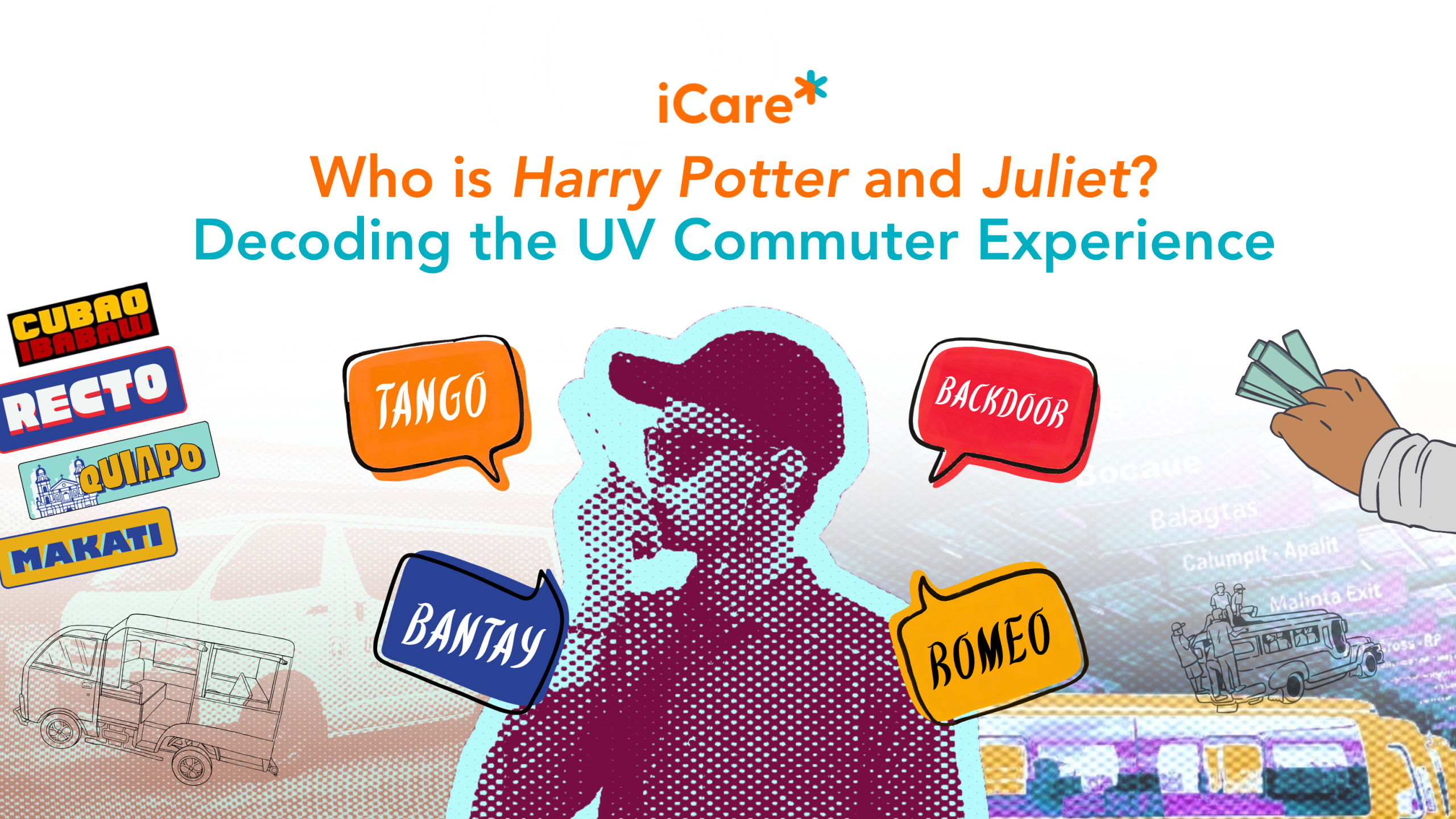
June 30, 2026 Who is Harry Potter and Juliet? Decoding the UV Commuter Experience
Every Filipino knows that being a commuter in the Philippines is an entirely different experience. Change the weather a bit, and the difficulty level has reached a new phase.
In terms of travel and commute, the Philippines has done it extraordinarily; from the World War II surplus jeepneys to the local version of tuk-tuk, tricycles, it is safe to say Filipinos know how to go places. It is no surprise that even in the daily mundane experience of commuting, the culture has developed its own lingo: the jeepneys’ para po and UV Express drivers’ unique communication codes.
Speaking the Language of the Commute
If you have ever experienced being a UV Express commuter, you might have heard of some numerical terms that do not make sense to others, such as 10-12, which means standby or wait; 10-49, meaning a traffic situation; or 10-50, which could mean an accident.
Most UV drivers use coded language to communicate with each other, based on numerical radio codes and the NATO Phonetic Alphabet.
Drivers only adapted these phonetic alphabet codes to refer to other words that begin with their assigned letters, which paved the way to some entertaining codes, such as Harry Potter and Juliet, which means “highway patroller” and “jeepney,” respectively.
Over the years, new jargon emerged as older drivers tried to adjust to drivers who did not know all the codes. They also learned to use jargon for landmarks and organizations to which they are signed. For instance, UV drivers would use Baga to refer to the Lung Center; 16 ni Erap for Sandiganbayan; and Limang Letra for Land Transportation Franchising and Regulatory Board (LTFRB).
READ NEXT: Don’t Drink and Drive: Why Injuries Caused by Breaking the Law May Not Be Covered by Your HMO
The Purpose Behind the Phrases
One might find the whole system to be full of a sense of humor, but aside from Filipino drivers having the ability to make an experience a memorable one, there is a reason for the use of these codes and jargon.
Most of the jargon and codes used by the UV drivers help them inform each other of the traffic situation, ensuring that they will take the safest and easiest route.
It also allows them to communicate the passengers’ location to each other while informing one another whether they still have the capacity. Drivers also noted that the jargon and codes helped warn drivers about road scenarios that could involve an interaction with an enforcer.
But why the need for some sort of secrecy in their communication, you ask?
There is a reason the codes are not decipherable for others. They need to keep their communication confidential because if their frequency is joined by speed limit enforcers, the officers will know that the drivers are giving each other hints.
And the main concern is mainly the take-home pay; for drivers, being caught by enforcers means having less pay.
While these codes may sound amusing to outsiders, they reflect the resourcefulness of Filipino drivers and the unique culture that has emerged from everyday commuting. Understanding these practices provides a deeper appreciation of the realities faced by transport workers and commuters alike.
This perspective also underscores how informal systems of communication often emerge in response to practical gaps in formal transportation structures. In many cases, these coded exchanges become an adaptive tool that helps maintain efficiency in an environment where timing, coordination, and awareness are crucial to both driver livelihood and passenger mobility.
Beyond transportation, similar concerns about immediacy and access extend to other aspects of daily life, particularly health and emergency situations where preparation and timely response are essential. In this context, prepaid healthcare models offered by providers such as iCare reflect a broader shift toward more flexible and accessible forms of coverage designed to support urgent medical needs when they arise, especially for drivers who are often at higher risk and may require immediate access to emergency care in the event of accidents.
Ultimately, the coded language of UV Express drivers is more than a collection of quirky phrases—it is a practical system shaped by necessity, experience, and shared understanding. From traffic updates to passenger coordination and warnings on the road, these expressions reveal how communication evolves in response to everyday challenges. More than just a way to get by, these codes reflect the broader realities of commuting in the Philippines: a constant negotiation between efficiency, safety, and livelihood, where even language becomes a tool for survival and connection.
Sources and References
Matias, G. S. (2017). The study of English codes and jargons used by FX drivers of Robinsons’ Novaliches to TriNoma Mall trip. In Selected Proceedings of the International Conference: DRAL 3/19th ESEA 2017 (pp. 59–76). King Mongkut’s University of Technology Thonburi. https://sola.kmutt.ac.th/dral2017/proceedings/3-Papers/59-76_The%20study%20of%20English%20codes%20and%20jargons-Gladys%20Matias.pdf
Esquire Philippines article:
Uy, S. L. (2018, August 2). The secret language of the FX drivers has been decoded. Esquire Philippines. https://www.esquiremag.ph/culture/lifestyle/the-secret-language-of-the-fx-drivers-has-been-decoded-a1889-20180802
