



June 5, 2026 Why the Rebrand From CCAP to CXAP Matters More Than Most People Think
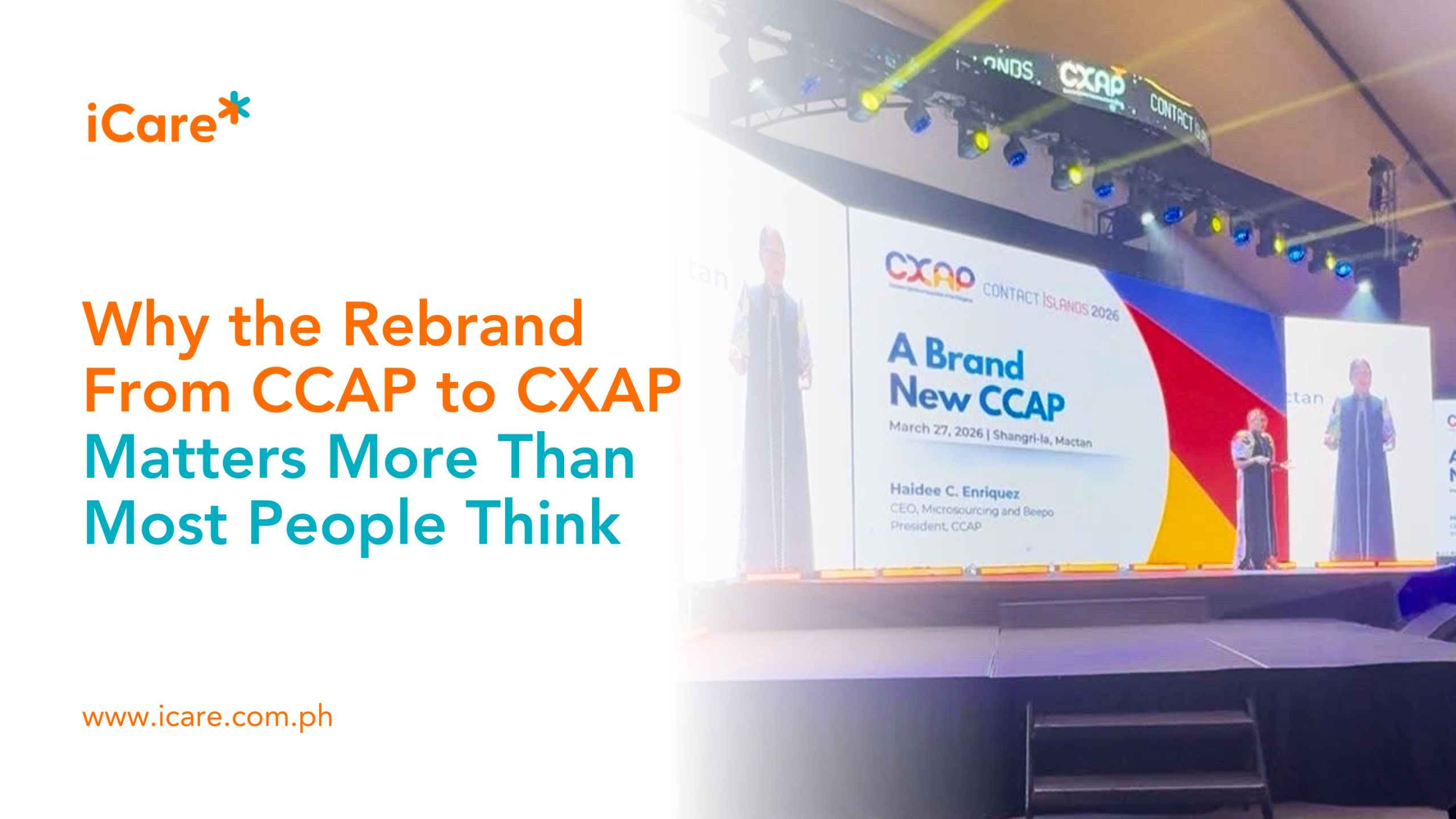
When industry leaders gathered at Shangri-La Mactan in Cebu from May 26 to 28, 2026 for Contact Islands 2026, many expected conversations around artificial intelligence, automation, customer behavior, and workforce transformation. Few expected one of the conference’s most significant announcements to be a change in name.
Yet the transition from the Contact Center Association of the Philippines to the Customer Xperience Association of the Philippines, or CXAP, may ultimately become one of the most consequential signals about where one of the country’s most important industries is heading.
At first glance, changing an industry association’s name may appear largely symbolic. In reality, the move reflects something much larger. The Philippine industry that once built its global reputation around voice services and contact centers is increasingly transforming into a broader ecosystem centered around customer experience, artificial intelligence, digital transformation, analytics, consulting, and higher-value services.
The significance of the announcement was reinforced by the person who formally introduced the new identity. During Contact Islands 2026, the unveiling of the CXAP name and logo was led by Haidee C. Enriquez, one of the most recognizable leaders within the Philippine customer experience industry. Enriquez currently serves as Chief Executive Officer of MicroSourcing and Beepo, has spent nearly two decades in leadership positions across the customer experience and outsourcing sectors, is an alumna of Harvard Business School, and was previously recognized as People Manager of the Year by the People Management Association of the Philippines. Her career has consistently focused on scaling organizations, workforce transformation, and strengthening the Philippine outsourcing ecosystem.
This transformation is happening at considerable scale.
Industry figures presented during Contact Islands 2026 showed that the Philippine Contact Center Business Process Management sector generated approximately 33.9 billion USD in revenues in 2025, representing nearly 84 percent of total Philippine IT-BPM industry revenues. Despite geopolitical uncertainty, changing policies in major markets, and accelerating AI adoption, the sector is projected to continue growing in 2026. This scale helps explain why even symbolic shifts in industry positioning matter. They influence talent strategy, investment priorities, government policy discussions, and global market perception.
The workforce story is equally significant.
Employment within the sector expanded significantly in recent years, bringing total industry employment to approximately 1.68 million people and reinforcing its position as one of the country’s largest private sector employers. These numbers challenge one of the more common assumptions surrounding artificial intelligence, namely that automation necessarily translates into large-scale workforce decline. Instead, the industry increasingly appears to be shifting toward different forms of work rather than simply reducing it.
This explains why the transition from CCAP to CXAP matters.
The term “contact center” reflects an industry largely defined by transactions. Customer experience reflects an industry increasingly defined by outcomes.
Executives speaking during the conference repeatedly emphasized that organizations are no longer simply handling customer inquiries. Companies are increasingly designing end-to-end customer journeys, deploying AI-enabled support systems, building omnichannel experiences, utilizing predictive analytics, and integrating human expertise with technology-driven operations. Filipino professionals are increasingly expected to solve more complex problems, deliver deeper customer engagement, and operate within more specialized functions. This evolution requires both technological capability and workforce transformation.
This shift creates new opportunities, but also new pressures.
As AI adoption accelerates, organizations face increasing demands to reskill employees, redesign workforce structures, and invest in more sophisticated talent capabilities. Emerging roles such as AI trainers, prompt engineers, AI solutions architects, and customer experience specialists are beginning to reshape workforce requirements across the sector. The competitive advantage of the future may therefore depend less on labor arbitrage and more on the ability to combine technology with human capability.
The rebranding to CXAP therefore represents more than a refreshed logo or a new acronym.
It represents an acknowledgment that the Philippine industry has outgrown its traditional identity.
For more than two decades, the country established itself as one of the world’s leading contact center destinations. The next chapter may require something more ambitious: becoming one of the world’s leading customer experience destinations.
The announcement made in Cebu may therefore be remembered less as a rebranding exercise and more as a statement about where one of the Philippines’ largest industries believes its future lies.
